Governance and Remuneration Issues to Watch in Australia and New Zealand’s 2026 Proxy Season
Subscribe


Key Takeaways
- For ASX companies, repeat remuneration strikes are increasingly common. It is the quality of a board's response, not the strike itself, that is read as the real signal of governance health.
- Executive share sales are drawing closer scrutiny, particularly when timed close to material announcements, placing greater weight on trading windows and disclosure practice.
- Many companies enter this reporting cycle facing genuine softening in their sector or end-markets, and companies are flagging target-setting as a live challenge.
- Boards now treat AI literacy as a skills-matrix gap, recruiting directors with relevant technology experience or funding director-level training rather than relying on management briefings alone.
- Following allegations of conflicts, companies with a KPMG audit relationship may face scrutiny around data security and the integrity of any recent tender process.
Over the final months of 2026, hundreds of ASX and NZX-listed companies will hold their annual shareholder meetings, and investors will vote on thousands of AGM proposals.
In the first of a two-part series setting out the issues expected to shape board decision-making and institutional voting across Australia and New Zealand’s 2026 proxy season, this article deals with company practice on remuneration and governance, drawing on what we’ve heard from issuers and institutional investors during Glass Lewis' recent engagement meetings. Part two of the series will cover regulatory updates.
Executive Remuneration Issues to Watch
Response to Shareholder Opposition
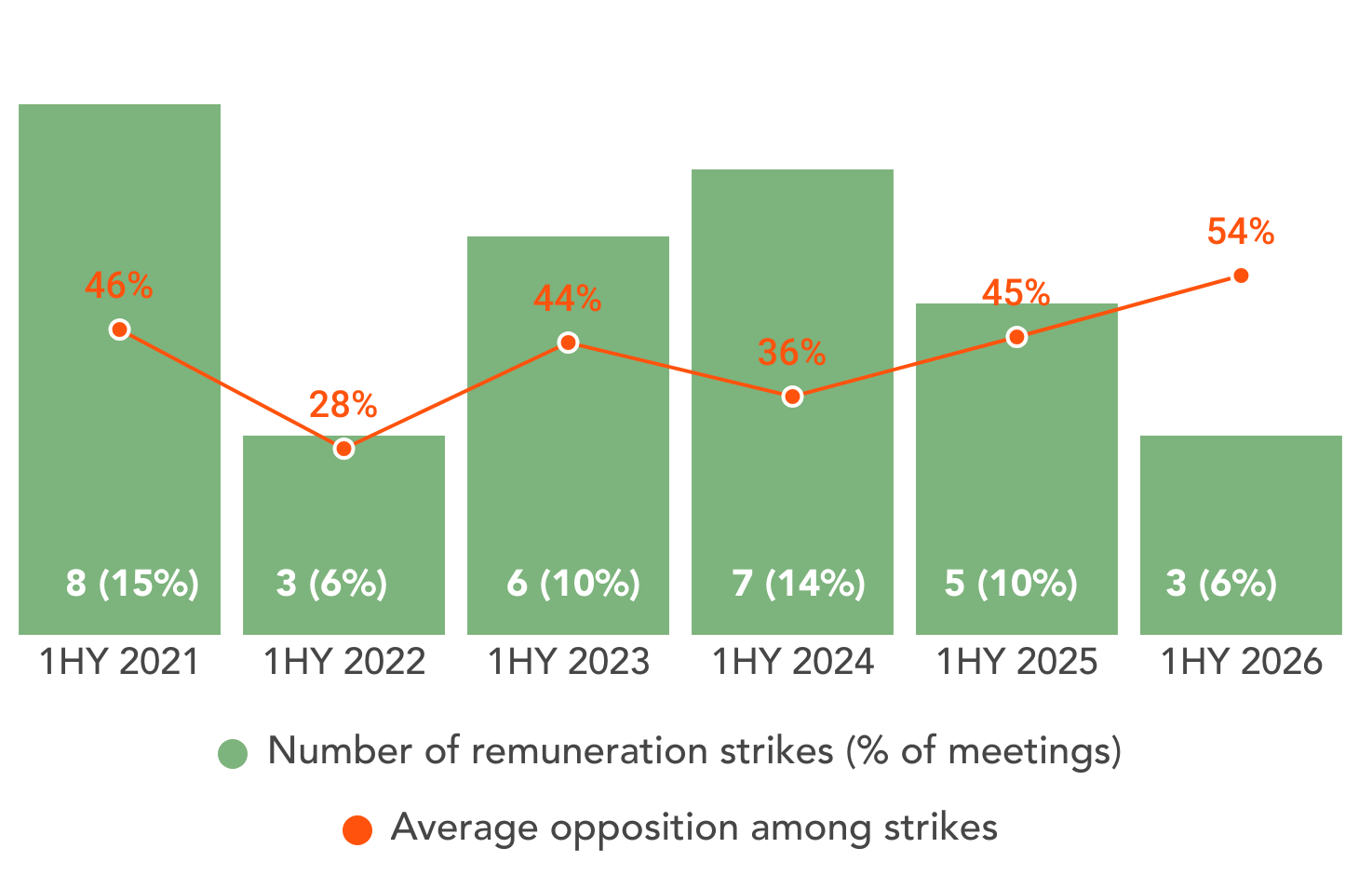
While the overall number of companies receiving 25% or higher opposition to remuneration proposal (strikes) has eased in 2025 and the first half of 2026, shareholder dissent and board responses remain a focus (Figure 1).
Figure 1. ASX 300 Remuneration Strikes, First Half 2021-2026
Source: Glass Lewis Research. Note: S&P/ASX 300 as of the September rebalance each year.
The volume of that dissent has shifted markedly, with repeat strikes now making up a growing share of the total. Investors often expect a remuneration report following a strike to set out a clear, specific response to the concerns raised, rather than a restatement of existing philosophy or incremental changes around the edges of a contested structure. This expectation is tested most severely at founder-led and insider-dominated boards, where founder or insider influence makes boards more resistant to changing course in response. It is the quality of a board's response, not the strike itself, that is read as the real signal of governance health.
Minimum Shareholding Requirements
Minimum shareholding requirements have featured consistently in this season's engagement discussions, with boards describing them as a direct response to shareholder feedback rather than a compliance formality. Several companies have introduced a minimum shareholding policy where none previously existed, or strengthened one already in place, citing investor and proxy adviser input following a period of shareholder dissent.
Executive share sales are also drawing closer scrutiny, placing greater weight on trading windows and disclosure practice. Sales timed close to material announcements, or that take a holding materially below policy, attract particular attention.
International Benchmarking and Pay Practices
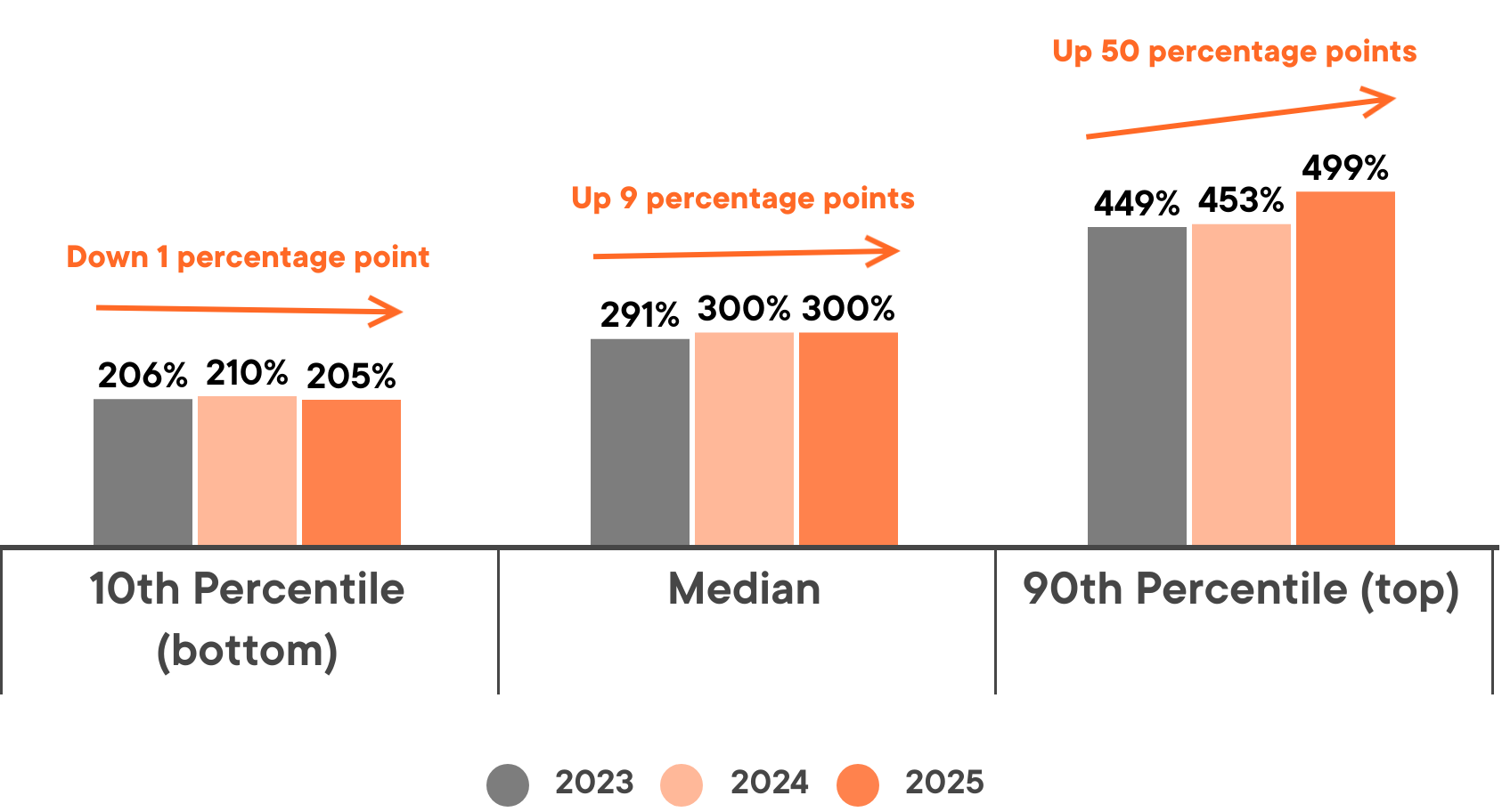
International benchmarking is one of the drivers behind the accelerated growth in top-end executive packages in recent years (see Figure 2 below, especially the 90th percentile).1 It often faces pushback from local investors, particularly when quantum is high and parts of awards lack a performance element.
Figure 2. S&P/ASX 100 CEO Total Incentive Opportunities
Source: Glass Lewis Research. S&P/ASX 100 as of the September rebalance each year.
Boards may legitimately need to have regard to pay practices in other markets to attract and retain executives competing in an international talent pool. The concern is that international benchmarking, applied by default or too loosely, will over time draw Australian remuneration toward the more generous practices of some offshore markets. Boards are therefore expected to apply international comparators selectively and with a clear commercial or strategic rationale, rather than as a routine means of justifying higher quantum.
Target Setting in a Softer Market
Many companies enter this reporting cycle facing genuine softening in their sector or end-markets, and many of the boards we’ve engaged with are flagging target-setting as a live challenge.
A softer economic cycle brings the calibration of incentive targets into sharper focus. When conditions are weakening, targets risk being set in ways that protect payouts rather than test performance, and vesting outcomes become harder for shareholders to interpret with confidence. A well-designed plan should distinguish genuine outperformance from results delivered by favorable external conditions. It should be robust enough that a materially weaker year produces a materially lower payout. The concern in a softening market is that this link loosens, with targets set below the previous year's actual result and no adequate explanation offered.
Investors expect boards to demonstrate that vesting outcomes reflect real, sustained performance rather than the mechanical clearing of an undemanding hurdle. They also expect disclosure of the actual level of achievement against each target. Transparency around how targets are set and how they relate to previous performance and prevailing conditions will be central to maintaining shareholder confidence through a weaker part of the cycle.
CEO Succession
Chief executive succession has been a recurring subject in this season's engagement discussions, with a significant number of companies managing a transition this year. Boards typically set out the process behind a transition: whether the search was internal or external, how long planning had been under way before an appointment was announced, and how the board satisfied itself the process was competitive.
Remuneration is a related pressure point, though practice has not settled in one direction. Some boards reset the incoming chief executive's pay against the market, above or below the predecessor's, while others hold it largely unchanged. In both cases, boards are prepared to justify the position by reference to the predecessor's package and to market data.
Governance and Oversight Issues to Watch
Artificial Intelligence
Board-level engagement with artificial intelligence has moved beyond pilots and strategy statements. Some companies are now front-running the investment case, committing capital to AI-driven productivity and treating capability in this area as a source of competitive advantage rather than a compliance matter. There is a harder edge to this shift: the first rounds of AI-attributed workforce reductions are appearing, and some companies face challenge from AI-native competitors, or from customers using the technology to do in-house what they previously bought.
On board composition, many boards now treat AI literacy as a skills-matrix gap, recruiting directors with relevant technology experience or funding director-level training rather than relying on management briefings alone.
Auditor Conflicts of Interest and Tendering Integrity
Auditor conflict of interest has moved sharply up the governance agenda following allegations that KPMG partners2 used confidential client information to gain an advantage in tendering for audit work. The matter, aired before a parliamentary committee, raises questions that reach beyond the firm itself.
Companies with a KPMG audit relationship may face scrutiny, and should be prepared to account for their response to the controversy, including their engagement with the firm since it emerged and whether any implicated individuals were involved in decisions affecting the company. Some boards will also be expected to seek assurance from the firm about data security and the integrity of any recent tender process. Boards should also be prepared to explain how they manage the potential conflicts of interest of ex-partner directors, particularly during a tender process.
The episode has sharpened attention on the structural features that make audit tenders unusually high-stakes. Audit partners must rotate every five years under Australian law, but there is no limit on the tenure of the firm itself – so a successful tender can secure a client relationship of indefinite duration. Some jurisdictions address this directly: in the EU, public interest entities (listed companies, banks and insurers) must rotate audit firms after a maximum of ten years, extendable to 20 with a public tender.3
Treasury's recent consultation on “Regulation of accounting, auditing and consulting firms in Australia,”4 on which submissions closed in August 2026, canvassed potential interventions ranging from giving the Australian Securities and Investments Commission (ASIC) direct power to sanction firms through to mandatory firm rotation and structural separation of audit and consulting practices.
Conclusion
As the 2026 proxy season gets underway, investors will be watching how boards respond to a set of increasingly interconnected remuneration and governance challenges. On executive remuneration, the key issues will be the quality of board responses to shareholder opposition, the strengthening and enforcement of minimum shareholding requirements, the use of international benchmarking to justify higher pay, the calibration of incentive targets in a softer market, and the remuneration decisions accompanying CEO succession.
On governance and oversight, AI and auditor integrity are emerging as particularly important tests of board effectiveness. Investors will be looking for evidence that boards have the expertise to oversee both the opportunities and workforce implications associated with AI, while recent controversy in the audit market puts renewed emphasis on auditor independence, tender integrity, data security and potential conflicts of interest.
Notes and References
1 Bielawska, Alice. “The Upward Drift in S&P/ASX 100 CEOs’ Variable Incentive Opportunity.” Glass Lewis. July 14, 2026. https://www.glasslewis.com/article/the-upward-drift-in-s-p-asx-100-ceos-variable-incentive-opportunity
2 Ittimani, Luca. “KPMG loses contracts and leaders amid scandal over alleged confidential leaks.” The Guardian. June 9, 202t6. https://www.theguardian.com/australia-news/2026/jun/10/kpmg-scandal-alleged-confidential-leaks-contracts-lost-leaders-quit-ntwnfb
3 Accountancy Europe. “Mandatory rotation of auditors. Streamlining European countries’ Audit rules.” 2022. https://accountancyeurope.eu/wp-content/uploads/2022/12/Audit-Rotation-2022_Accountancy_EU.pdf?v1
4 Australian Treasury. “Regulation of accounting, auditing and consulting firms in Australia.” https://consult.treasury.gov.au/c2026-781711


.jpg)