



Key Takeaways
- The number of governance proposals in the U.S. went up despite an overall decline in shareholder proposal volume.
- Investors are increasingly emphasizing the financial materiality of E&S issues.
- AI-related proposals are shifting from general principles/oversight to concrete governance questions.
- Proponents are submitting more company-specific shareholder proposals, rather than one-size-fits-all.
With the 2026 proxy season now completed, this article shares four observations about the shareholder proposals that went to vote at U.S. companies this year, the topics these proposals covered, how they were targeted, and how investors approached them.
Observation #1: The number of governance proposals went up despite an overall decline in proposal volume.
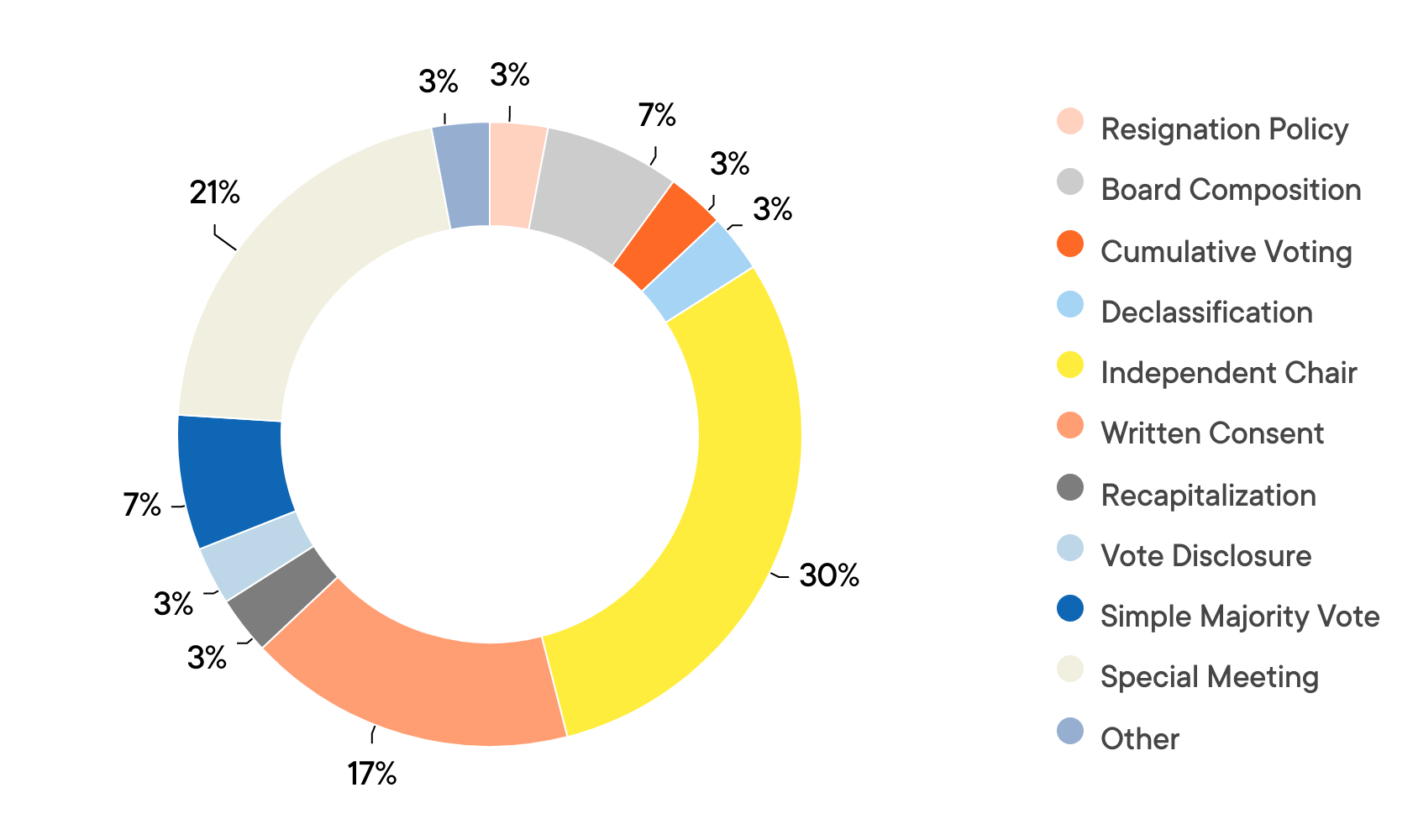
Breakdown: This year, we reviewed approximately 29.7% more governance proposals than last year. Just over 30% of these proposals this year requested an independent chair or the separation of the CEO and chair positions. As shown in in Figure 1, investors continued to press companies for the right to call a special meeting; 49 resolutions were submitted, with all but two requesting a threshold of 10% outstanding stock to have the power to call a special meeting. Moreover, 39 resolutions (or 17% of the governance proposals we reviewed this proxy season) requested the right to act by written consent. Board composition and board declassification were also prominent issues in the 2026 proxy season, accounting for 16 and 8 proposals, respectively.
Figure 1. Proxy Season 2026 Governance Proposals by Topic
Source: Glass Lewis Research.
Why this is important: Companies may want to prioritize governance engagement given that shareholders have increasingly been raising several core governance issues.
Observation #2: Investors are increasingly emphasizing the financial materiality of environmental and social (E&S) issues.
Breakdown: In 2026, a range of shareholder proposals have illustrated this point.
- A proposal filed at Markel Group requested a report describing the firm’s strategies and action plans for mitigating material environmental risks related to its business.
- A proposal at ArcBest requested the adoption of targets for measurably reducing its GHG emissions (which are deemed material by the Sustainability Accounting Standards Board), and to report annually on its progress.
- Proposals at Tyson Foods and Walmart requested reporting on how the impact of recent changes to U.S. immigration policy and enforcement is impacting those companies’ operations.
- Proposals at Alphabet and Meta Platforms were focused on the risks of AI data sourcing, an issue that was first raised in 2024 at Microsoft.
Some proponents looked beyond emphasizing material financial risk to requesting that E&S initiatives be measured against financial outcomes using NPV or ROI metrics.
Why this is important: Material risks from E&S issues can affect long-term shareholder value, revenue or profitability, costs, and can also have regulatory and legal implications, thereby affecting a company’s license to operate. Financial materiality aligns with the fiduciary duties of directors to ensure oversight and disclosure of such issues. Moreover, companies seeking to build successful environmental and social programs should anticipate shareholder interest and disclose relevant financial metrics.
Observation #3: AI-related proposals are shifting from general principles/oversight to concrete governance questions.
Breakdown: Proponents are moving beyond more general calls for responsible AI principles or risk disclosure, and have begun submitting proposals concerning AI's implications on capital allocation, data governance, climate commitments, and board accountability. While the specificity of these requests is increasing, shareholder support has remained relatively low compared to other governance-related proposals at these same companies.
AI proposals gained more prominence this year. We reviewed 11 shareholder resolutions on a variety of AI-related topics, including the risks of AI data sourcing (two), climate commitments and AI data centers (three), model bias (one), responsible AI (one), misinformation and disinformation (one), the workforce impacts from AI and automation adoption (one), risk management concerning deepfake content (one), and codifying board oversight of AI (one).
Ten of these resolutions were focused on U.S. companies, while one was focused on a Canadian company (Shopify). Average support was 8.9%, with no proposals receiving majority support. The highest level of support was 18.4% for a proposal at Amazon.com regarding its climate commitments amid growing energy demand from AI and data centers; this is down slightly from 20.1% in 2025 when it was first submitted at the company.
Why this is important: While companies’ investments in and use of AI technologies present significant growth opportunities, there are also significant risks, including a variety of legal, regulatory, and reputational risks. As such, companies should ensure appropriate oversight and risk mitigation strategies are in place to protect and/or enhance shareholder value. Nevertheless, shareholders appear ready to afford boards significant discretion in determining how oversight responsibilities should be structured, providing that companies can demonstrate that material risks are being effectively managed.
Observation #4: We’re seeing more company-specific shareholder proposals, rather than one-size-fits-all.
Breakdown: A proposal at HCA Healthcare requested that the board publish a report describing the healthcare consequences and impacts its hospital acquisitions in the last decade have had on local communities, including: (i) the number of physician departures post-acquisition; (ii) a comparison of pre- and post-acquisition patient satisfaction ratings; (iii) a comparison of the number of staff per occupied beds pre- and post-acquisition; and (iv) an assessment of the impacted community’s perception of HCA and response to the acquisition.
Further, a proposal at Berkshire Hathaway requested a report disclosing the board’s oversight framework for workforce and human capital management across its operating subsidiaries. Meanwhile, a proposal at Tyson Foods requested a report disclosing any steps the company is taking to address environmental and human health harms from waste lagoons in its owned facilities and its pork supply chain.
Additionally, a proposal at Apple requested the board to conduct an evaluation and issue a report assessing the risks and costs associated with its “continued entanglement” with the People’s Republic of China, to include clear, quantified information on: (i) the financial exposure under high-tariff scenarios and mitigation strategies; (ii) the dollar value of revenues and profits at risk from regulatory and geopolitical actions in China; and (iii) the timeline and cost implications of supply chain diversification away from China, among others.
Looking overseas, a similar resolution at UK-listed BP directed the company to disclose how it promotes a disciplined approach to capital expenditure in order to generate an acceptable return on capital for each new material oil and/or gas project, including an explanation of whether and how the company: (i) assesses the relative cost competitiveness of each project; (ii) accounts for cost overruns and delays in project schedules; and (iii) demonstrates how continued exploration capex creates value for shareholders.
Why this is important: A proposal that identifies a specific issue at a company shows that the proponent has analyzed the company’s circumstances and has linked the issue to the company’s financial performance or long-term shareholder value. As such, it is easier for other shareholders to understand why the requested action matters and to support the text of the resolution, given that it is clear and achievable.
On October 13, 2026, Glass Lewis’ North America Research team will hold a webinar reflecting on the key governance, voting and market developments that shaped the 2026 proxy season in the U.S. and Canada, and highlight insights from our Proxy Season Review reports. Sign up to participate.