

Key Takeaways
- More than 175 shareholder proposals have gone to a vote at Alphabet, Amazon and Meta Platforms over the last five years.
- Big tech shareholder proposals cover a wide range of environmental, social and governance topics, including emissions reduction goals, water usage, H-1B visa policy, hate speech, customer privacy, and share capital structure.
- A majority of independent Alphabet and Meta shareholders voted to remove dual-class share structures and establish a one-share, one-vote standard – but the proposals were not approved by an overall majority of shareholders due to those very dual-class share structures.
- The number of proposals related to artificial intelligence reached double digits for the first time, with the strongest support for proposals where AI intersected with broader questions of accountability, transparency, and long-term risk management.
- Shareholders are increasingly examining how companies govern the capex required to support AI development, the sourcing and use of training data, the environmental implications of data centers, and the adequacy of existing shareholder-rights frameworks.
While the U.S. proxy season is at its busiest in April, the high-water mark for shareholder proposals comes in late May and early June, when three of the five big tech companies hold their annual general meetings. Every year this decade, Alphabet, Amazon and Meta Platforms have received an outsized number of shareholder proposals, covering a wide-ranging mix of topics. Between just these three firms, over 175 shareholder proposals have gone to a vote over the last five years (Table 1).
Table 1. Combined Shareholder Proposal Volume and Voting Support at AMZN, META and GOOGL

Source: Glass Lewis Research.
This year saw fewer shareholder proposals, particularly on social topics, in line with market-wide trends. Meanwhile, the number of proposals related to artificial intelligence reached double digits for the first time, as investors examine these companies’ internal oversight and operational deployment of the groundbreaking technology.1
This article examines the shareholder proposals that went to vote at Alphabet, Amazon and Meta this proxy season and how they fared with shareholders, with a spotlight on AI-related resolutions.
Mix of Proposal Topics
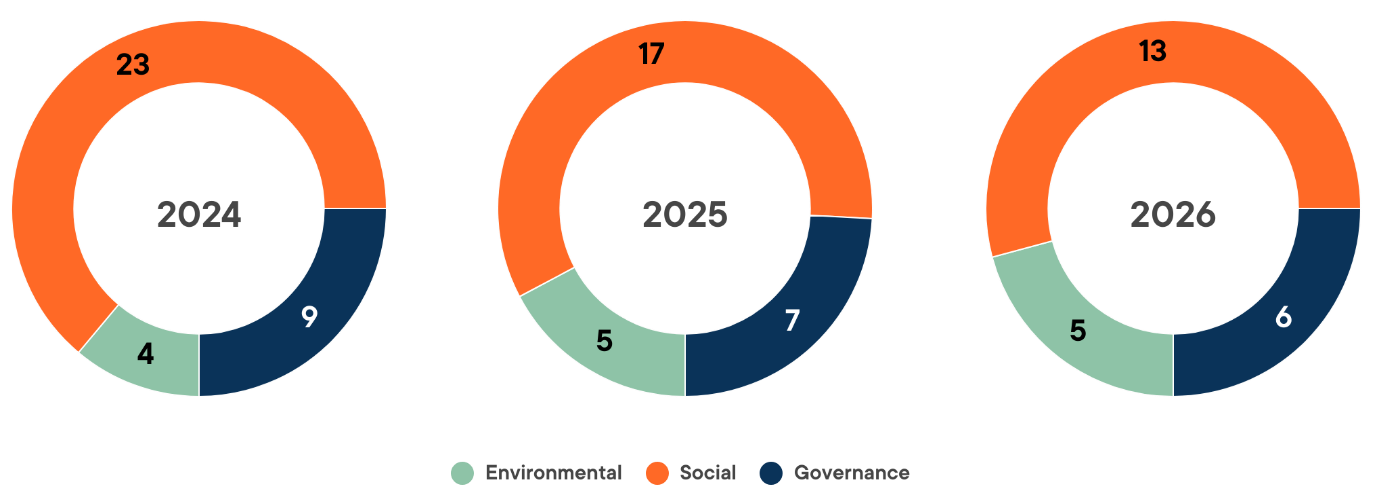
Beyond the sheer number of shareholder proposals submitted at large tech firms, the variety of environmental, social and governance issues these proposals cover underscores the extensive scope of these companies’ business activities and their pervasiveness in society (Figure 1).
Figure 1. Combined ESG-Related Shareholder Proposals at AMZN, GOOGL and META by Year and Topic
Source: Glass Lewis Research.
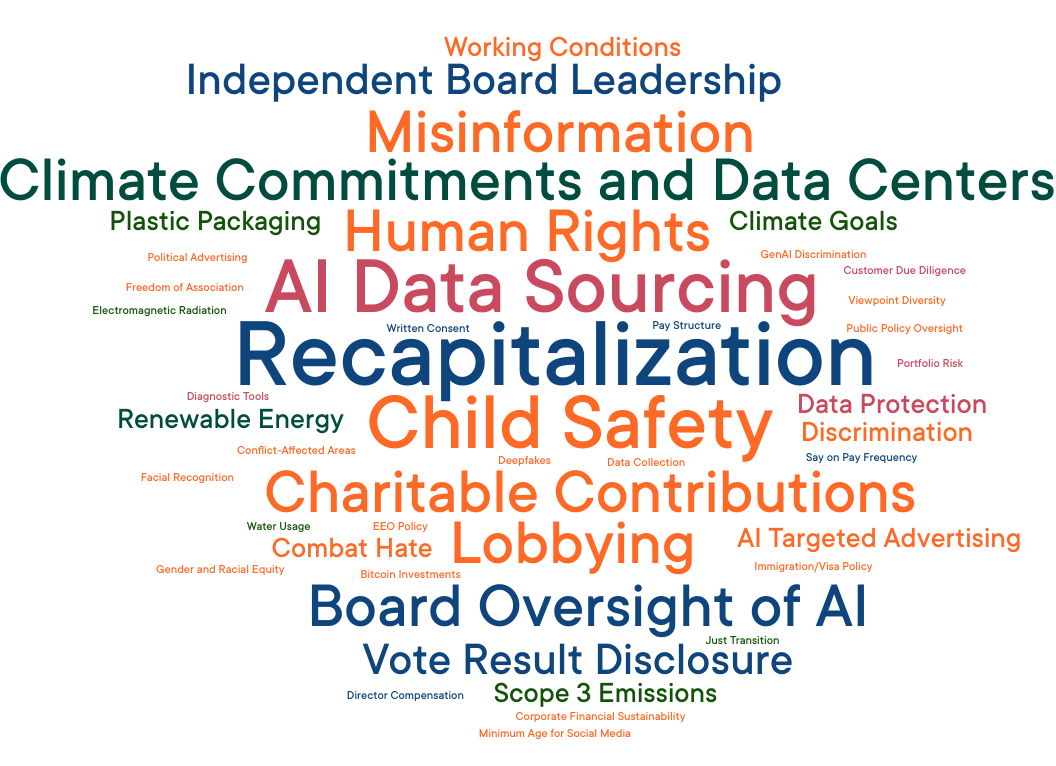
Despite a decline in the number of social proposals from 2024 to 2026, which reflects an ongoing, market-wide multi-year trend,2 investors continue to ask these companies to address a vexueciariety of topics (see Figure 2). For example, a single 2026 AGM ballot included shareholder proposals on H-1B visa policy, human rights in Gaza, antisemitism and hate speech, customer privacy, child safety, climate goals, vote result disclosure, and the company’s share capital structure.
Figure 2. Word Cloud of Alphabet, Amazon and Meta Shareholder Proposal Topics, 2024-2026
Source: Glass Lewis Research.
Proposal Exclusions
The Securities and Exchange Commission’s decision not to review no-action requests3,4 this season initially raised concerns that companies might be more aggressive in excluding shareholder proposals. However, that does not appear to have been the case with these companies. As in prior years, Amazon was the most active, filing seven exclusion notices in 2026, compared to twelve in 2025, while Alphabet and Meta took a more laissez-faire approach. The former filed one exclusion notice in each of the past two years, while the latter did not seek to exclude any shareholder proposals this season after filing two notices in 2025.
However, the absence of the SEC review appears to have had a significant impact on the ultimate shape of Amazon’s AGM ballot. In 2025, SEC staff only concurred with the company’s assessment that proposals were excludable on five of the twelve requests. Three proposals were withdrawn by the proponent, leaving four proposals making the AGM ballot despite the company’s attempt to exclude them. By contrast, none of the seven resolutions that Amazon sought to exclude in 2026 went to a vote, contributing to the year-on-year decline in the number of shareholder proposals at these companies (Table 1).
Vote Results: Recapitalization and Dual-Class Voting
With Alphabet and Meta’s current governance structures deviating from best practice expectations, it’s perhaps unsurprising that the most popular proposals at these companies covered governance topics. When thoughtfully crafted and appropriately targeted to address clear governance gaps, these types of proposals tend to draw relatively strong investor support. At their 2026 AGMs, both companies voted on ‘recapitalization’ proposals requesting the removal of dual-class share structures and establishment of a one-share, one-vote standard; the proposals received 26.5% support at Meta and 31.2% at Alphabet. Notably, the very existence of those dual-class share structures skews the extent of shareholder support for their removal. At both companies, founders control a majority of voting power (60.8% at Meta and 52.9% at Alphabet, as of the AGM) despite owning less than 20% of the company’s economic value, due to special classes of shares that carry ten votes each.
A majority of shareholders supported the recapitalisation proposals, which flatten this structure to give all shares the same voting power. In line with support for one-share, one-vote, a majority of shareholders at Meta supported a proposal requesting that say-on-pay votes be held annually, rather than triennially; and a proposal requesting that the company’s vote result disclosure include a breakdown by share class received near-majority support.
Spotlight on AI Proposals
While a broad range of shareholder proposals can be applicable to these companies, certain topics, such as artificial intelligence, are particularly relevant to their operations. In each of the past three years, shareholder proposals both directly and indirectly related to the growing proliferation of AI have been submitted to these companies.
These represent the overwhelming majority of AI-related proposals that have gone to a vote at all companies, across the market. In 2024, a number of media and entertainment companies (including Paramount, Netflix, and Warner Bros. Discovery) were targeted with AI proposals, likely as a result of the integral role of AI technologies in the 2023 actors and writers guild strikes. However, in 2025, all but one of the 2025 proposals and all but two of the 2026 proposals dealing with companies’ use of AI were submitted at companies that are in the tech sector (Apple, IBM), or adjacent (Block, Shopify, Tesla).5
Table 2. Combined AI Shareholder Proposal Volume and Voting Support at AMZN, META and GOOGL

Source: Glass Lewis Research.
AI Proposals by Topic
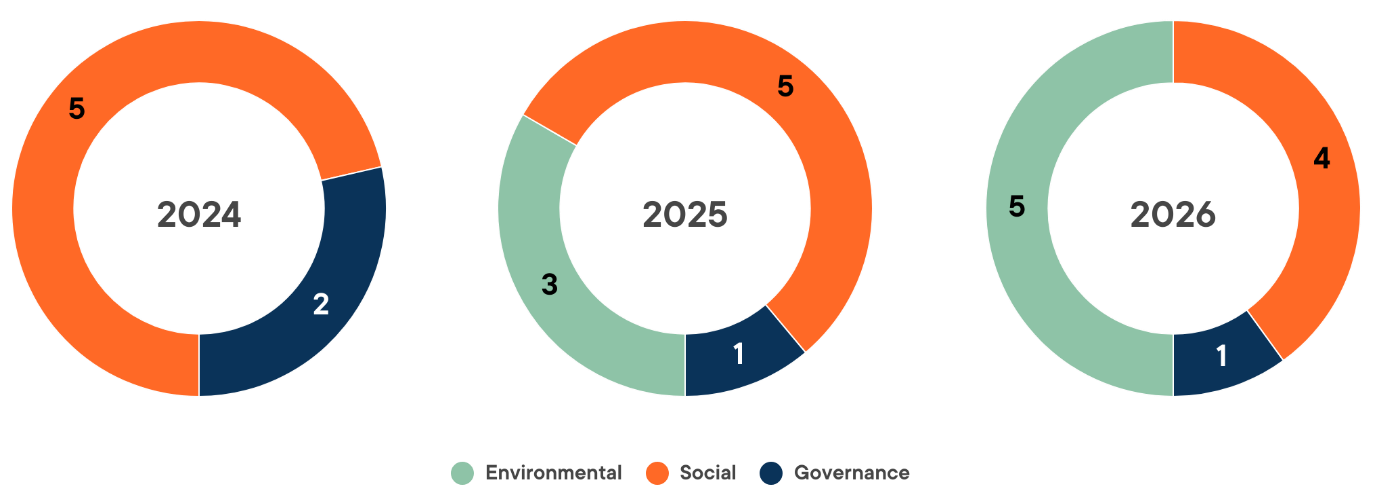
Similar to the overall mix of shareholder proposals applicable to these companies, AI-related proposals cover an array of topics. In addition to growing expectations that boards define an internal framework for AI oversight and governance, its deployment carries environmental, social, legal and reputational implications and risks – particularly at companies where the technology is central to products and operations.
Figure 2. Combined AI Shareholder Proposals at AMZN, GOOGL and META by Year and Topic
Source: Glass Lewis Research.
In each of the past three years, the societal risks related to AI have consistently been a focus of shareholder proposals, covering issues like the human rights impact of AI advertising, generative AI discrimination, and risks related to deepfakes (i.e., seemingly realistic, but machine learning-fabricated, multimedia and video). Meanwhile, in the past two years, more attention has been placed on environmental topics related to AI. This came despite a consistent decrease in the overall number of environmental shareholder proposals since 2023, and may reflect increased public scrutiny on data center externalities, particularly their water and energy use.
Voting on AI Proposals
AI proposals at Alphabet, Amazon and Meta received 7.6% support on average in 2026, down from 9.8% in 2025 and 21.4% in 2024. The highest result was at Amazon, where 18.4% of shareholders voted in favor of a request for reporting on how data centers and AI will impact the company’s ability to meet existing greenhouse gas emissions reduction targets. The same proposal received 20.1% support at Amazon in 2025, and this year similar resolutions received 7.4% support at Alphabet and 6.9% support at Meta.
As discussed above, Alphabet and Meta’s use of dual-class share structures means that the voting results provide an under representative picture of investor sentiment. Taking unequal voting rights into account, the proposal supported by the highest proportion of minority shareholders focused on AI data sourcing. The resolution, submitted by the National Legal and Policy Center, called on these companies to assess the risk to “operations and finances, and to public welfare, presented by the real or potential unethical or improper usage of external data in the development, training, and deployment of its artificial intelligence offerings.”6 It received 10.2% support at Meta (compared to 9.9% in 2025) and 12.3% at Alphabet (compared to 12.4% in 2025).
Notably, proposals dealing with AI governance, including a resolution at Alphabet calling for the board’s audit committee to be officially responsible for AI oversight, and one at Amazon to form a worker-oriented AI advisory council, received much lower support than other governance proposals at these companies (3.7% at Alphabet, and just 0.001% at Amazon). This illustrates that although investor expectations for director oversight of AI are increasing, they are also applying a sophisticated analysis, reluctant to override the board unless the proponent has identified a clear problem, and their proposed solution makes sense. The result at Alphabet may also reflect concerns that audit committees are being stretched thin by the emergence of new risk areas,7 potentially contributing to a rise in accounting issues.8
Conclusion
Ultimately, the voting outcomes on shareholder proposals at Alphabet, Amazon, and Meta – and particularly those on AI-related proposals – illustrate how investors are evaluating board oversight when multiple governance and operational challenges converge. Rather than treating artificial intelligence as a standalone technology risk, shareholders are increasingly examining how companies govern the substantial capital expenditures required to support AI development, the sourcing and use of training data, the environmental implications of expanding data center infrastructure, and the adequacy of existing shareholder-rights frameworks. The strongest support tended to emerge where AI intersected with broader questions of accountability, transparency, and long-term risk management.
These results also suggest that investor expectations regarding AI oversight are evolving. The conversation has moved beyond abstract calls for responsible AI principles or general risk disclosures and toward more concrete governance questions concerning capital allocation, data governance, climate commitments, and board accountability. At the same time, the relatively low support for prescriptive AI governance proposals – despite other governance-related proposals receiving relatively strong support at these companies – indicates that investors continue to afford boards significant discretion in determining how oversight responsibilities should be structured, provided companies can demonstrate that material risks are being effectively managed.
Notes and References
1 Wenger, Sarah. “US AI Oversight Through Three Lenses: Investor Expectations, the S&P 100 and Company-Specific Analysis.” Glass Lewis. February 26, 2026. https://www.glasslewis.com/article/us-ai-oversight-through-three-lenses-investor-expectations-sp-100-company-specific-analysis
2 Keatinge, Courteney. "The Evolving Investor Approach to Climate: Examining Shareholder Proposals as a Forum on Climate Change, Reporting and Emissions." Glass Lewis. December 18, 2025. https://www.glasslewis.com/article/the-evolving-investor-approach-to-climate-examining-shareholder-proposals-as-a-forum-on-climate-change-reporting-and-emissions
3 U.S. Securities and Exchange Commission. Division of Corporate Finance. "Statement Regarding the Division of Corporation Finance's Role in the Exchange Act Rule 14a-8 Process for the Current Proxy Season." November 17, 2025. https://www.sec.gov/newsroom/speeches-statements/statement-regarding-division-corporation-finances-role-exchange-act-rule-14a-8-process-current-proxy-season
4 “Tracking Shareholder Proposals and Company Exclusions: Mid-Season Observations”. Glass Lewis. May 13, 2026. https://www.glasslewis.com/article/tracking-shareholder-proposals-and-company-exclusions-mid-season-observations
5 The only exception in 2025 was a proposal at Berkshire Hathaway asking for the creation of a board committee charged with overseeing AI-related issues; in 2026, Walmart had a proposal covering workforce impacts from AI and automation, and The Southern Company had a proposal requesting a report on data center costs.
6 Alphabet. DEF14A. April 24, 2026. https://www.sec.gov/ix?doc=/Archives/edgar/data/1652044/000130817926000342/goog-20260424.htm
7 Nolledo, Sam. “Director Commitments Policies, Overboarding, and Board Refreshment.” Glass Lewis. March 11, 2024. https://www.glasslewis.com/article/director-commitments-policies-overboarding-and-board-refreshment
8 Clements, Joah. “Why Are Accounting Errors on the Rise at U.S. Public Companies?” Glass Lewis. April 3, 2024. https://www.glasslewis.com/article/why-are-accounting-errors-on-the-rise-at-u-s-public-companies