2026 Proxy Season Global Trends Part 1: Shareholder Rights, Governance and Meeting Formats
Subscribe

Key Takeaways
- A surge in state-to-state U.S. reincorporations has seen many companies moving to Texas.
- U.S. bylaw amendments saw special meeting rights and shareholder rights plans in focus.
- India enhanced its related party transaction disclosure and shareholder oversight of secretarial auditors.
- Korea’s new, binding rules on treasury shares sparked a wave of proposals.
- Globally, year-on-year variation in shareholders’ ability to attend meetings in person is minimal.
In the first instalment of our 2026 Proxy Season Global Trends, we provide a rundown of key takeaways relating to shareholder rights and corporate governance from around the globe. Glass Lewis clients can access the full 2026 Proxy Season Global Briefing, which also covers executive pay, board composition and shareholder activism, via the content libraries on Viewpoint and Governance Hub.
The 2026 proxy season saw companies in several markets take a different approach to meeting format. Regulatory reforms intended to support shareholder rights impacted meeting agendas in several Asia-Pacific markets, while the U.S. saw increased focus on special meeting rights and shareholder rights plans along with a continuing surge of state-to-state reincorporations.
Trends on Rights & Governance
A surge in state-to-state U.S. reincorporations has seen many companies moving to Texas.
- 44 U.S. companies sought to reincorporate, marking a significant increase compared to previous years (vs 28 in 2025, and 17 in 2024).
- 20 of these proposed to reincorporate away from Delaware, while 13 companies proposed reincorporating to Delaware.
- The number of companies that sought to reincorporate to Texas increased significantly to 16 in 2026, compared to two in 2025.
U.S. bylaw amendments saw special meeting rights and shareholder rights plans in focus.
- Management-submitted proposals providing shareholders with special meeting rights increased significantly from last year. This topic was a major focus for shareholder proposals in both 2025, when nine of the 63 proposals submitted received majority support, and 2026. This season, many agendas included competing proposals on the topic from shareholders and management.
- Proposals seeking to either amend or adopt shareholder rights plans experienced a notable increase compared to the prior year, with half the proposals relating to net operating loss (NOL) pills.
India enhanced its related-party transaction disclosure requirements and introduced shareholder oversight of secretarial auditors.
- The ongoing 2026 proxy season has seen an influx of new proposals after listed entities became subject to revised requirements for the appointment of secretarial auditors in April 2025. Secretarial auditors typically review compliance with laws and regulations, equivalent to a corporate secretary.
- The Securities and Exchange Board of India also updated disclosure rules for related-party transactions in late 2025, which has resulted in more substantive, detailed reporting this season, particularly on commercial rationale and transaction structure.
Korea’s new, binding rules on treasury shares spark a wave of proposals.
- Effective from March 2026, the Korean Commercial Act requires companies to cancel newly acquired treasury shares within one year of acquisition (or within 18 months for shares acquired before the amendments took effect). Companies may retain treasury shares only for specified purposes-such as business needs or executive and employee compensation-with annual shareholder approval.
- During the 2026 AGM season, 15.6% of companies sought shareholder approval to retain treasury share under these exceptions.
- Separately, effective June 2026, the Capital Markets Act was amended to expand treasury share disclosure requirements to all listed companies (this previously only applied where treasury shares represented 1% or more of outstanding shares). Companies must disclose their treasury share holdings, disposal plans, and disposal status twice a year.
Trends on Meeting Format
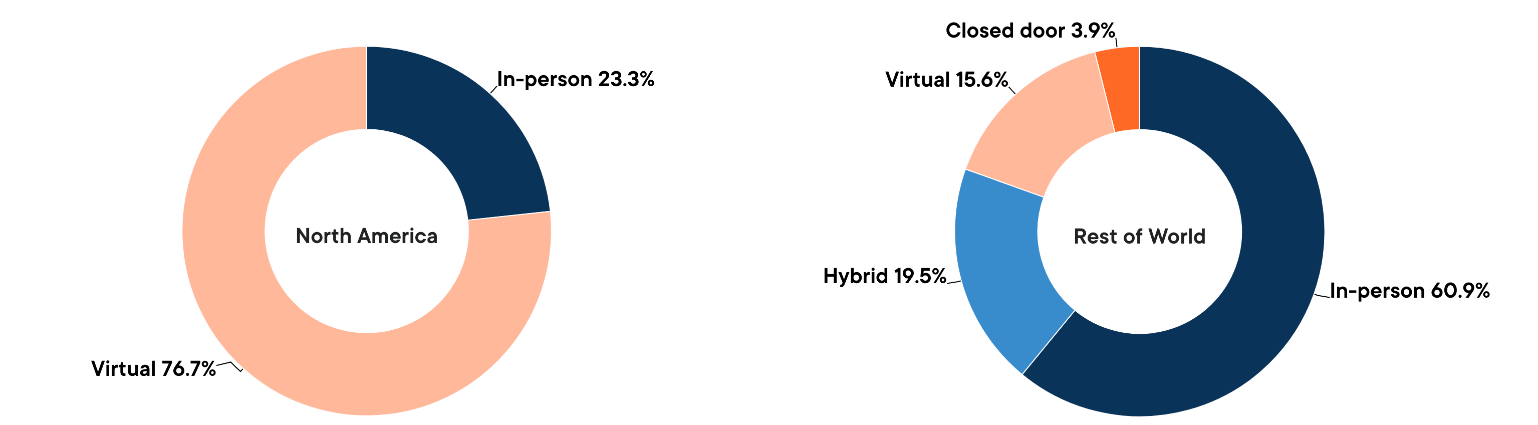
Globally, year-on-year variation in shareholders’ ability to attend meetings in person is minimal.
- Germany saw a significant decline in virtual-only meetings. After local investors raised concern with the format in 2025, this year its prevalence dropped from two-thirds to less than half this year among blue chip companies.
- In Spain, the proportion of virtual-only meetings more than doubled this season – from 9% in 2025 to 20% in 2026 among large caps, and from 3% to 10% among small and mid-caps. However, hybrid or in-person meetings remain the norm, accounting for over two-thirds of total.
- Otherwise, existing market practice appears to have stabilized.
Figure 1. General Meeting Format.
Source: Glass Lewis Research.
- In-person or hybrid meetings remain the prevalent meeting format in some large markets such as the UK, France, Sweden, Switzerland, China, Hong Kong, Taiwan, Korea, and Japan.
- Virtual-only or remote/closed-door shareholder meetings were common practice in the U.S., Brazil, Italy, Norway, Thailand, and the Philippines.
- Within North America, meeting practices for large companies continue to diverge. The largest U.S. companies continue to adopt virtual-only formats in large numbers (~77% virtual-only), while Canadian companies prefer formats with an element of physical participation (~39% virtual-only).
Noteworthy Local Regulatory Developments
- Italy: “Closed-door” meetings, which shareholders are unable to attend in-person or virtually, are already the preferred format and may become easier to implement going forward. The long-awaited reform of the Consolidated Law of Finance, implemented in April, could remove the need for companies to gain statutory approval from shareholders to hold meetings in a closed-door format.
- Netherlands: In the Netherlands, the Digital General Meeting for Private Law Legal Entities Act was approved in June 2026 and is expected to enter into force later in the year, creating a permanent framework for digital and hybrid shareholder meetings. Dutch listed companies must continue to hold annual general meetings either in person or in a hybrid format, although fully digital meetings may be permitted for other general shareholder meetings.