

Key Takeaways
- In North America, the number of failed say-on-pay proposals was down by more than 20%, particularly outside the S&P 500.
- While fixed and incentive pay went up, failed remuneration votes remained highly unlikely among large European companies.
- After record levels of remuneration strikes in 2023 and 2024, Australian shareholder dissent fell, with 33 S&P/ASX300 pay strikes.
- Initially implemented by UK multinationals as a means of addressing overseas competition for talent, hybrid incentive plans are trickling down to smaller FTSE issuers.
- One-time awards and increases at the top of the U.S. market drove an increase in average CEO pay, while in Canada median CEO pay growth was more pronounced at small/mid-size companies.
In the third instalment of our 2026 Proxy Season Global Trends, we provide a rundown of key takeaways relating to executive pay from around the globe. Glass Lewis clients can access the full 2026 Proxy Season Global Briefing, which also covers shareholder rights and governance, director voting, board composition and shareholder activism, via the content libraries on Viewpoint and Governance Hub.
Trends on Shareholder Voting
Average North American say-on-pay support increased slightly year-over-year, and the number of failed proposals was down by more than 20%, particularly outside the S&P 500.
- Among four failed S&P 500 proposals, two (Warner Bros. Discovery and Thermo Fisher Scientific) were repeat offenders, also failing to receive majority support for the say-on-pay proposal in 2025.
- Excessive CEO granting practices were at the center of all four failed S&P 500 say-on-pay votes.
- Only one Canadian say-on-pay proposal failed to receive majority support, Allied Properties Real Estate Investment Trust. S&P/TSX 60 constituent Intact Financial Corporation barely passed, with 52.7% support.
Failed remuneration votes remained highly unusual across large UK and European companies.
- One retrospective remuneration report proposal failed to receive majority support (Danish company Pandora). In addition, two OMX Copenhagen 25 companies' remuneration reports did not receive majority support: NKT and Zealand Pharma.
- Only one prospective proposal was rejected, an advisory vote on the management board remuneration policy of Adidas, which received 31.9% support. Other contentious policy votes took place at Montea (55.1% support), Sacyr (60.4%), and Brenntag (63.3%).
- No FTSE 100 remuneration proposals were rejected, and the number of UK remuneration reports attracting shareholder dissent of over 20% fell from seven to one year-on-year.
After record levels of remuneration strikes in 2023 and 2024, Australian shareholder dissent fell, with 33 S&P/ASX300 pay strikes.
- In the most recent proxy season, there were 33 pay strikes at S&P/ASX300 constituents – down ~17% from the prior two years, but still elevated compared to the preceding decade, where strikes ranged from 11-26.
- While the number of strikes declined, the severity of shareholder dissent behind the strikes generally intensified, with 8 strikes attracting more than 65% of votes against (2024: 5, 2023: 4).
- Repeat strikes also remained elevated with 39% of the recorded strikes being consecutive strikes (2024: 33%, 2023: 12%). Companies with influential figures such as founders, long-tenured CEOs or major shareholders on the board feature heavily in this group.
- Key drivers continue to include preferential executive treatment and pay-for-performance misalignment.
Support for long-term incentive plans declined at Brazilian large cap companies.
- Average shareholder support for long-term incentive plans (LTIPs) fell to 66.9% (compared to 75% in 2025). Many of these plans allowed for the participation of non-executive directors.
Trends on Pay Quantum
Fixed and incentive pay rising in Europe.
- Close to six in ten large cap European companies increased CEO fixed pay in FY2025, including the vast majority in Nordic Europe and across the UK and Ireland. France was the outlier, with only around a quarter of companies raising base salary.
- Among companies that raised fixed pay, the median increase was approximately 5% across Europe. France and Italy had the steepest median rises.
- Only 24.6% of UK fixed pay increases exceeded the wider workforce rate (42.6% in 2025).
- Approximately four out of ten companies voting on new remuneration policies proposed to increase maximum pay opportunity under incentive plans, led by the UK and Ireland, followed by Iberia and Italy. Increases averaged above 20% for STI plans, and nearly 19% for LTI plans.
- Similarly, nearly six in ten new policies included increased CEO salary. Fixed pay increases associated with a new remuneration policy were particularly widespread across Nordic Europe, the UK and Ireland.
Transatlantic pay gap: hybrid incentive plans trickle down in the UK.
- A number of UK companies outside the FTSE 100, largely in the property sector, sought to introduce U.S.-style hybrid share plans, which include a time-based award component, without an international competitiveness argument. This may mark the start of a creep in scope of incentive arrangements intended to support companies competing with markets in which executives have higher, and more relaxed, pay.
- While no FSTE 100 companies proposed such a plan this year, Smith & Nephew plc expanded the scope of its existing hybrid plan, in conjunction with quantum increases. These issues contributed to 40.3% of shareholders voting against SN’s remuneration report – the highest dissent in the FTSE 100.
Increases to non-executive director fees were widespread across Europe, while modest in size.
- Increases to non-executive directors’ fees were more widespread than in FY2025 across most of Continental Europe, with the highest incidence in Benelux, Nordic Europe and Iberia.
- The median increase was 13% for Continental Europe overall, with Iberia the highest at approximately 23%. Across the Nordics, Benelux, DACH and Iberia, increases are being proposed frequently but in smaller amounts, indicating more incremental adjustments.
One-time awards and increases at the top of the U.S. market drove an increase in average CEO pay.
- The total value of one-time awards, and average award size, continued to trend upward. In the S&P 500, $2.7 billion in one-time awards were granted, up 40.8% from the prior year, with average values increasing by 22.7% to $3.7 million. This drove average CEO pay up 17.8% compared to 2025, to $11.5 million. For the Russell 3000, $8.6 billion in one-time awards were granted, up 47.6% from the prior year, with average award size up 34.1% to $2.3 million.
- While the average value of individual sign-on awards fell slightly year-over-year, that of most other one-time award categories saw significant rises compared to the prior year. This was, in part, driven by awards at the top end of the value range.
- The number of S&P 500 CEOs with pay packages of $100 million+ doubled from 5 in 2025 to 10 in 2026.
- Median CEO pay growth continued, though more slowly than in recent years among the S&P 500.
Figure 1. Median U.S. CEO Pay ($M)
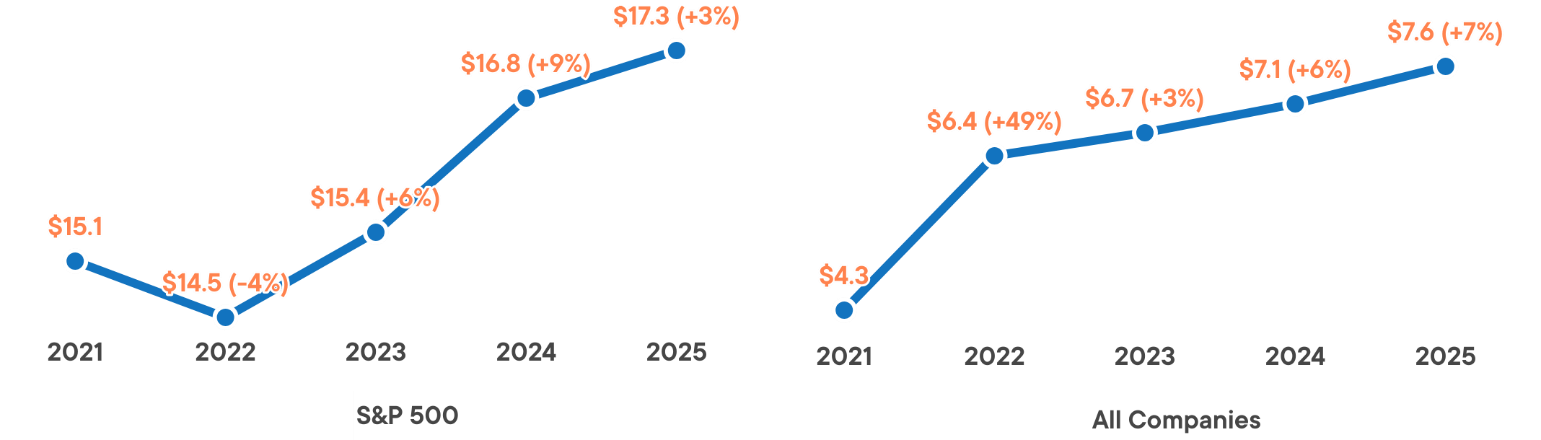
Source: Glass Lewis Research. Note: Chart above reflects financial years, where 2025 data was reported & voted in 2026.
In Canada, median CEO pay continued growing, particularly at small/mid-size companies.
- Median CEO pay increased approximately 14% year-over-year, from $4.1 million to $4.7 million, while average CEO pay increased approximately 16.9% (from $6.9 million in 2025 to $8.0 million).
- GFL Environmental topped the list, with the CEO’s compensation coming in at over $168 million.
- For the S&P/TSX 60, median pay increased 2.2% year-over-year, from $9 million to $9.2 million. However, average pay decreased year-over-year, from $13.2 million to $10.8 million (down 18.1%).
- This appears largely due to the top end of total CEO pay figures being substantially lower. For example, the highest paid CEO in both 2026 and 2025 was Tobias Lütke at Shopify — but his total dropped from $167 million in 2025 to $44.4 million in 2026.
Figure 2. Median Canadian CEO Pay ($M)
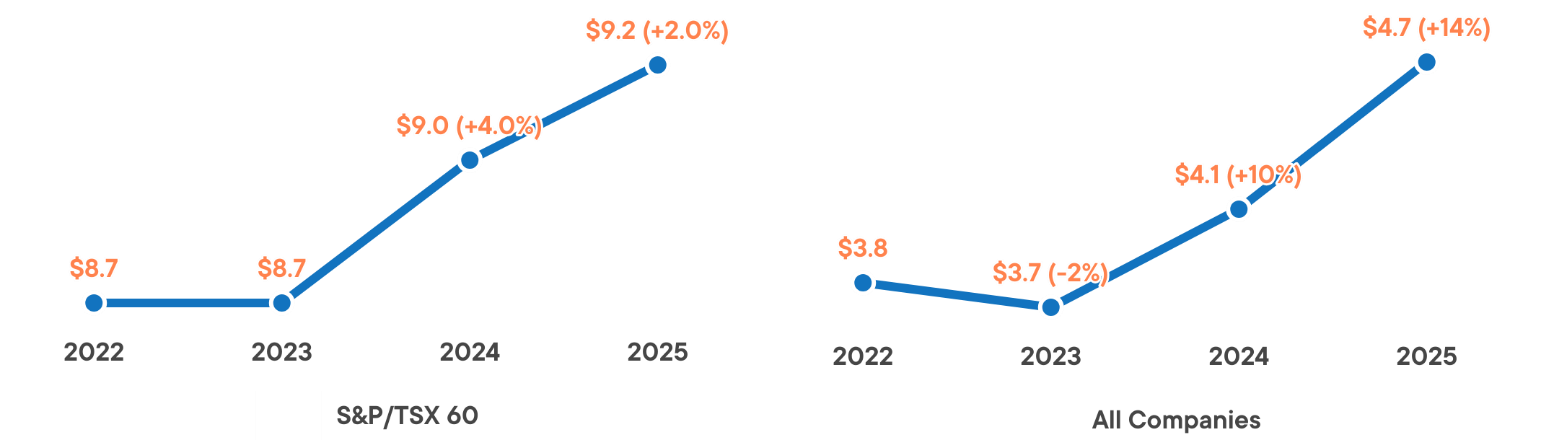
Source: Glass Lewis Research.



.jpg)