
Key Takeaways
- Since the 2011 Copé–Zimmermann Law implemented a 40% board gender diversity requirement for French corporate issuers, the proportion of women directors has increased significantly.
- While nearly half of SBF 120 board members are women, gender diversity levels decline markedly when looking at leadership roles such as CEO and board chair.
- The EU’s Women on Boards Directive and French decree of 30 July 2025 have changed how board gender diversity is calculated, to account for employee shareholder representatives and employee representatives.
- The need to comply with the new rules will require companies to adapt their nomination and appointment processes.
The European Women on Boards Directive, adopted in 2022 and transposed into French law on Oct. 15, 2024, aims to strengthen gender balance on corporate boards. The directive was introduced more than ten years after the Copé–Zimmermann Law first implemented board gender diversity requirements for French corporate issuers. The directive also complements the existing legislative framework.
This article discusses the impact of recent legislative changes on board diversity requirements in France, and provides an overview of gender representation within leadership positions in 2025.
History of Gender Parity Legislation in French Listed Companies
Copé–Zimmermann
The 2011 Copé–Zimmermann Law1 introduced a requirement for French boards of directors to include at least 40% members from the underrepresented gender. For boards with eight members or fewer, the difference between the number of men and women may not exceed two directors.
Women on Boards Directive
The European Union’s Women on Boards Directive2 applies to companies listed on a regulated market with more than 250 employees and either €50 million (US$ 57.5 million) in revenue or €43 million ($49.5 million) in total assets.3 Compared to Copé–Zimmermann, the main change introduced by the Directive concerns the basis used to calculate compliance with the quota. Employee-shareholder representatives (who are elected by shareholders) are now included in the group of directors subject to the 40% gender requirement.
By contrast, employee representatives (who are elected by employees, not shareholders) remain in a separate category, although they are now subject to specific gender balance rules established by the decree of July 30, 2025 (see New Compliance Challenges, below).4
Gender Balance Among Executives, Chairs, and Board Members in France
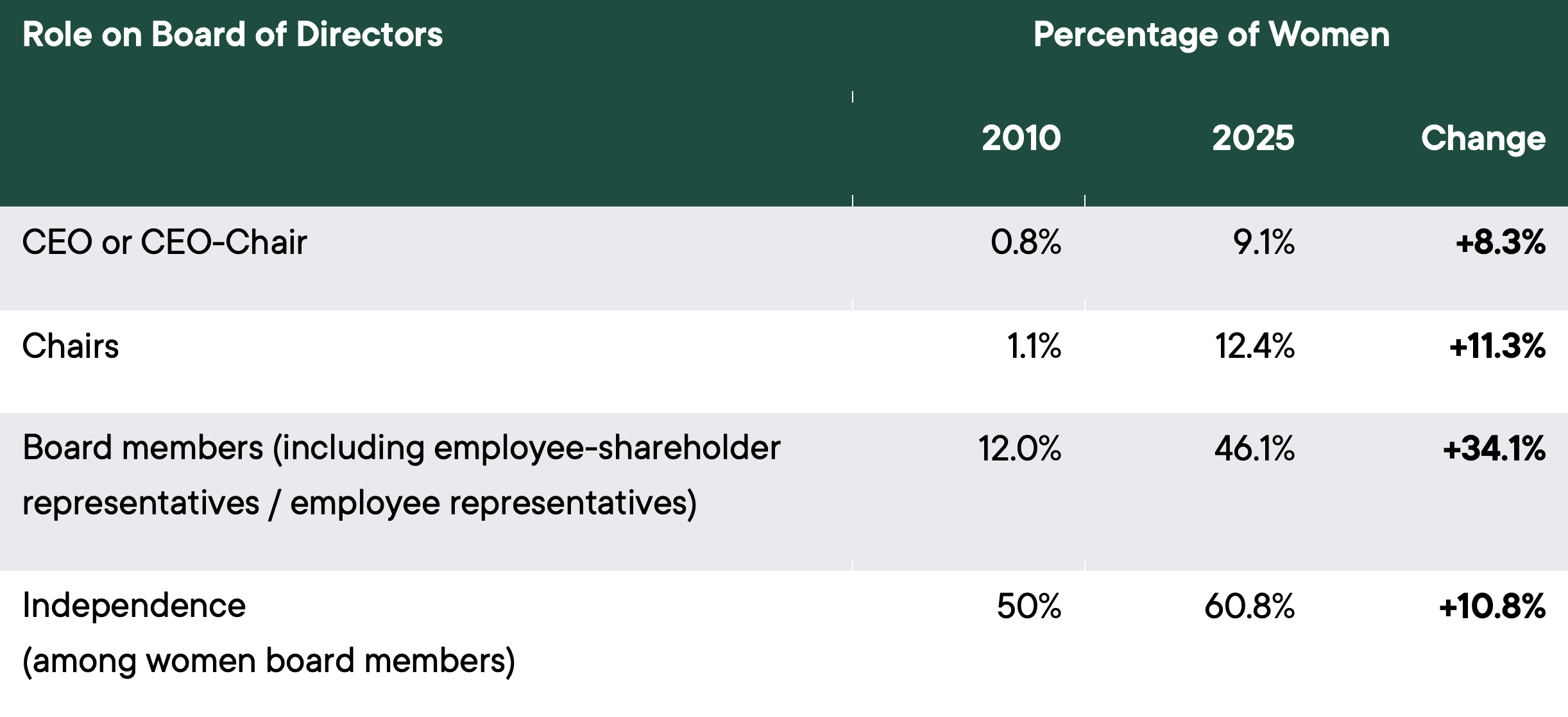
Since the adoption of the Copé–Zimmermann Law, the proportion of women serving as chairs, chief executive officers and board members has increased significantly. Table 1 below compares gender representation in the SBF 120 in 2010 and 2025, highlighting the significant progress made since the law’s introduction. Despite these increases, women remain significantly underrepresented in chair and CEO positions. They are also somewhat underrepresented on boards in 2025, although the gap is less pronounced.
Table 1. SBF 120 Board Gender Diversity 2010 vs. 2025
Source: Proxinvest Research.
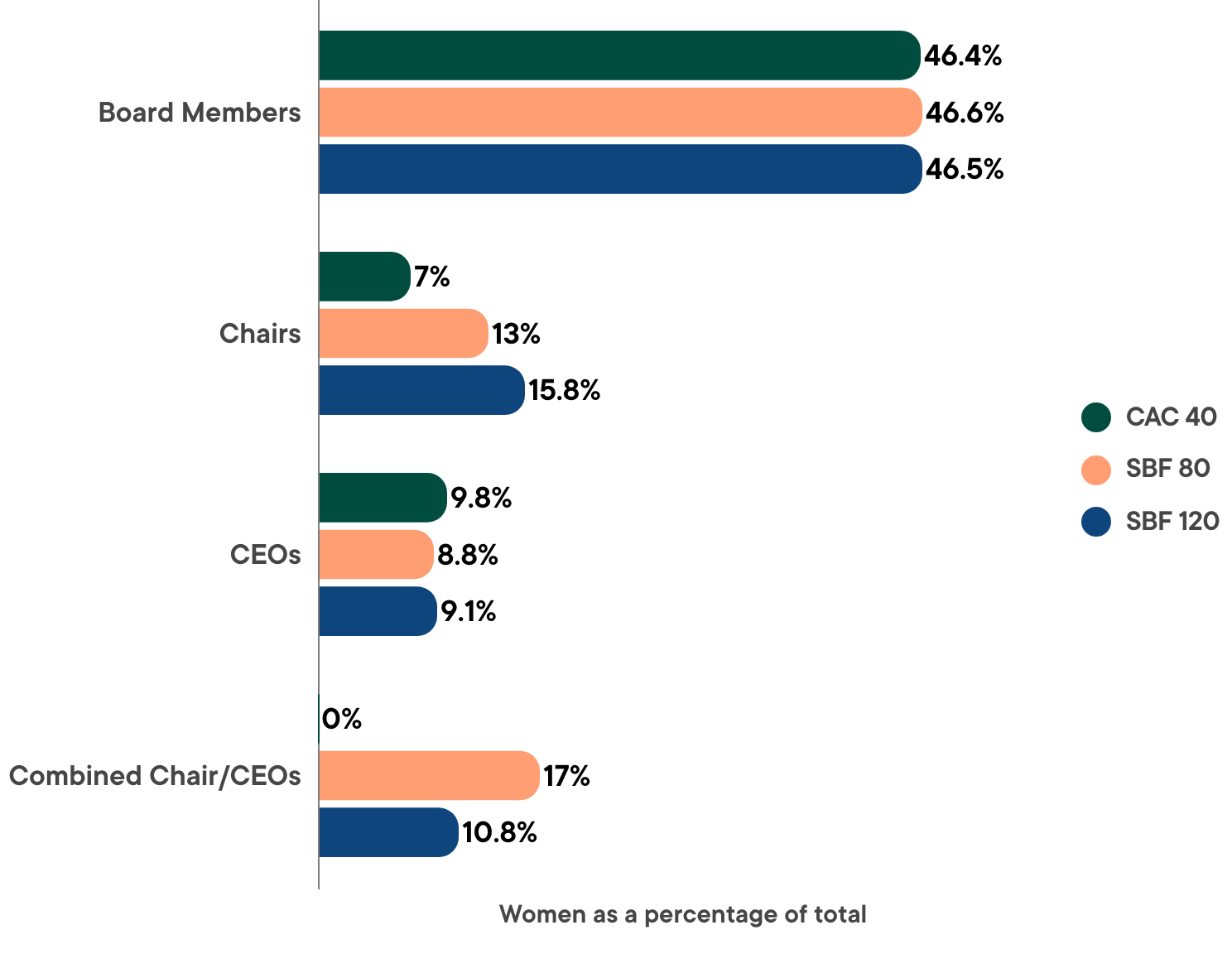
When employee-shareholder and employee representatives are excluded, the overall gender diversity rate in 2025 was slightly higher, ranging from 46.4% among CAC 40 boards to 46.6% across the SBF 80 (Figure 1).
Notably, female representation declines markedly across the SBF 120 when leadership roles are involved. Less than 10% of CEO positions in each index are held by women, and within the CAC 40, there are currently no women serving as combined chair and chief executive officer (CEO-chair). The SBF 80 and SBF 120 show stronger representation, with women making up 17% and 10.8%, respectively, of the CEO-chairs on these indices.
Similarly, 15.8% and 13% of non-executive chairs in the SBF 120 and SBF 80, respectively, are women — approximately double the proportion observed in the CAC 40, where only 7% of chairs are women.
Figure 1. Proportion of Women Serving as Board Members, Chairs and CEOs in 2025
Source: Proxinvest Research. Note: Calculations exclude employee shareholder representatives and employee representatives.
Including employee-shareholder representatives in the 40% quota — as required under the new legislation — would slightly increase the average gender diversity rate on SBF 120 boards. Because employee-shareholder representatives are predominantly women (58.8%), their inclusion raises the average share of women on SBF 120 boards to 46.8%.
New Compliance Challenges
As noted above, French law now includes employee-shareholder representatives in the calculation of the 40% quota, while employee representatives remain excluded. However, employee representatives are still subject to specific gender balance requirements under the decree of 30 July 2025.
The decree introduces new rules governing the appointment of employee representatives, which vary depending on the voting system used.5 It also establishes procedures to follow if board gender balance requirements are not met. The minimum number of representatives from the underrepresented gender varies depending on the total number of representatives serving on the board. Where there are fewer than two employee representatives, the requirements do not apply.
As a result of the updated approach to employee representatives, some companies that previously complied with the Copé–Zimmermann Law will now need to adjust their board composition. In total, as of June 2025, two companies within the SBF 120 did not meet the new requirements of the July 2025 decree, as they each had three employee representatives who are all men.
Conclusion
The transposition of the Women on Boards Directive reinforces a policy effort that has been underway for more than fifteen years, to improve gender balance on French corporate boards. While the proportion of women on boards has increased substantially since the introduction of the Copé–Zimmermann Law, women remain underrepresented in executive and chair positions.
The new rules — particularly the inclusion of employee-shareholder representatives in the 40% quota and the introduction of specific requirements for employee representatives — will require companies to adapt their nomination and appointment processes.
More broadly, these developments demonstrate that gender balance is no longer simply a regulatory obligation. It has become a long-term governance and diversity issue that is central to the effectiveness of corporate boards and management.
Notes and References
1 Law No. 2011-103 of 27 January 2011 on the balanced representation of women and men on boards of directors and supervisory boards (Copé-Zimmermann Law). https://www.legifrance.gouv.fr/jorf/id/JORFTEXT000023487662/
2 Directive (EU) 2022/2381 of the European Parliament and of the Council of 23 November 2022 on improving the gender balance among directors of listed companies and related measures. https://eur-lex.europa.eu/legal-content/EN/TXT/?uri=uriserv%3AOJ.L_.2022.315.01.0044.01.ENG
3 U.S. dollar conversions as of March 2026.
4 Decree No. 2025-744 of 30 July 2025 aimed at improving gender balance on the boards of directors and supervisory boards of certain commercial companies. https://www.legifrance.gouv.fr/jorf/id/JORFTEXT000052031944#:~:text=les%20hommes%20...-,D%C3%A9cret%20n%C2%B0%202025%2D744%20du%2030%20juillet%202025%20visant,surveillance%20de%20certaines%20soci%C3%A9t%C3%A9s%20commerciales
5 Employee representatives are appointed either through trade unions or two-college elections.