Bank CEO Pay on the S&P 500: How One-Time Awards Impact Compensation and Benchmarking
Subscribe


Key Takeaways
- A stark divergence between average and median pay growth for S&P 500 bank CEOs indicates that the sector-wide average was pulled upward by a limited number of unusually large pay packages.
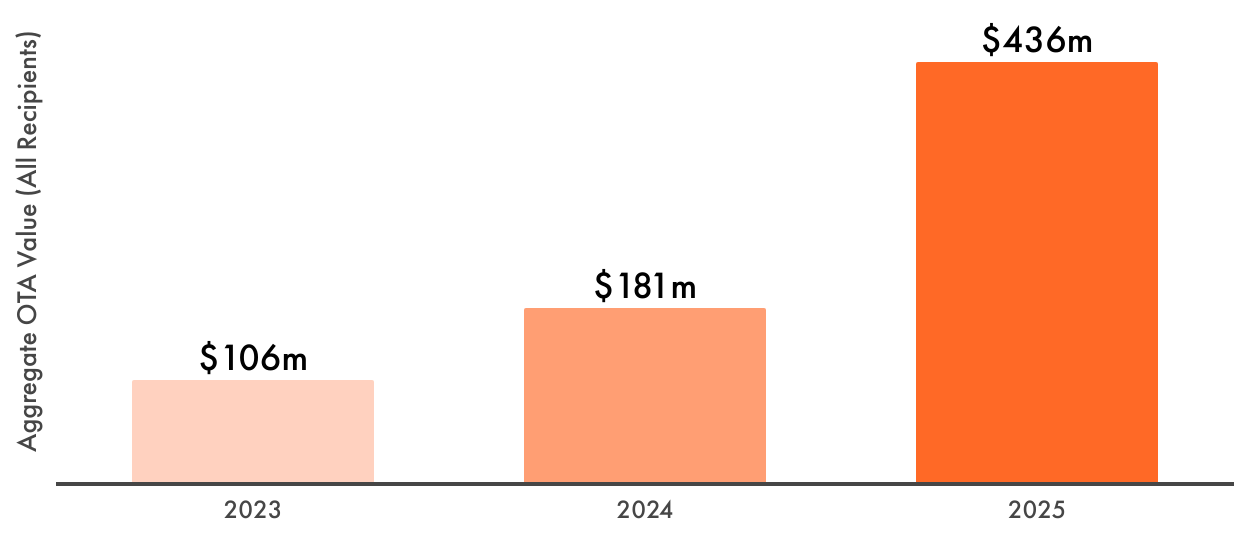
- One-time awards were a significant factor, with the aggregate value for grants across the sector rising from a little over $100 million in FY 2023 to above $430 million in FY 2025, representing an approximate 311% increase.
- The total was highly concentrated, with just five of the twelve banks that granted one-time awards in FY 2025 accounting for nearly 87% (approximately $379 million) of the aggregate recorded value across the sector.
- Several banks cited their peers in explaining the awards. Once an exceptional award enters the peer data, it can become support for the next exceptional award, even where the underlying retention threat is not clearly evidenced.
During fiscal year 2025, several large U.S. banks granted significant one-time awards (OTA) to their CEOs, primarily for retention, leadership continuity and transaction-related considerations. The awards contributed to a substantial increase in average CEO compensation among the 19 S&P 500 banks reviewed, while median compensation remained relatively stable. This article examines the growing use and value of one-time awards in the banking sector, their effect on reported CEO compensation, and how they impact peer benchmarking.
Average Pay, Median Pay and the Benchmarking Problem
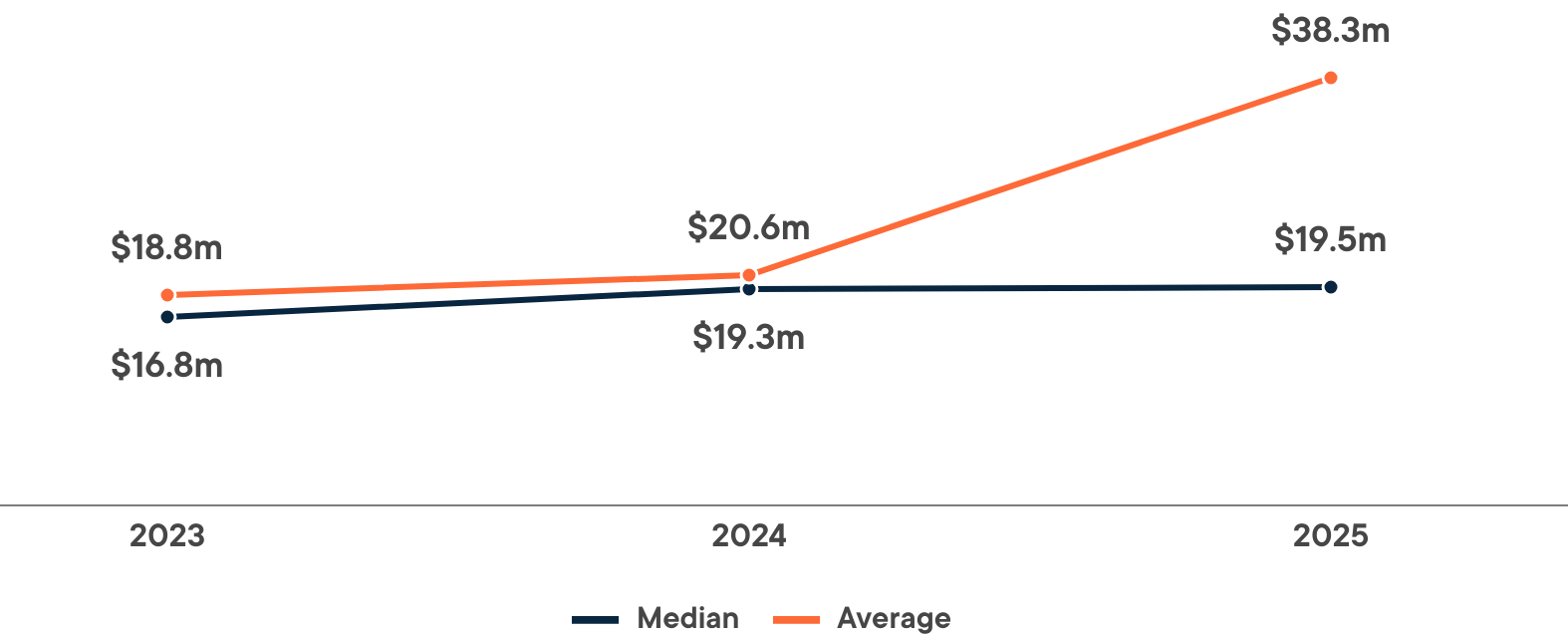
For 19 banks within the S&P 500, average reported CEO compensation increased from $18.8 million in FY 2023 to $38.3 million in FY 2025, while the median increased from $16.8 million to only $19.5 million (Figure 1). It is common for average CEO pay to exceed the median because a few especially large packages can pull the average upward. What stands out is just how wide that gap became in FY 2025: the average rose approximately 86% from the prior year, while the median was essentially unchanged. This indicates that the sector-wide average was pulled upward by a limited number of unusually large pay packages rather than a broad reset in typical CEO compensation.
Figure 1. Average vs. Median S&P 500 Banks CEO Compensation, 2023 - 2025
Source: Glass Lewis Research. Note: Sample includes 19 S&P 500 banks, FY 2023-FY 2025. The sample focused primarily on companies operating as large banks, including diversified banks, regional banks, custody banks and other institutions with significant banking operations. Companies whose primary businesses were insurance, payment processing, mortgage REITs, consumer finance or investment management were generally outside the intended scope.
This has a practical benchmarking implication. If a company relies on the average of a peer group or cites the average as evidence that its CEO’s pay package is below market, a few OTA-inflated pay outcomes can create an artificially high reference point. Indeed, the FY 2025 average reflected several exceptional compensation outcomes and was therefore less representative of the compensation reported by a typical company in the sample. This is not a new issue; rather, FY 2025 provides an illuminating illustration of it.
One-Time Awards Became a Sector-Level Issue
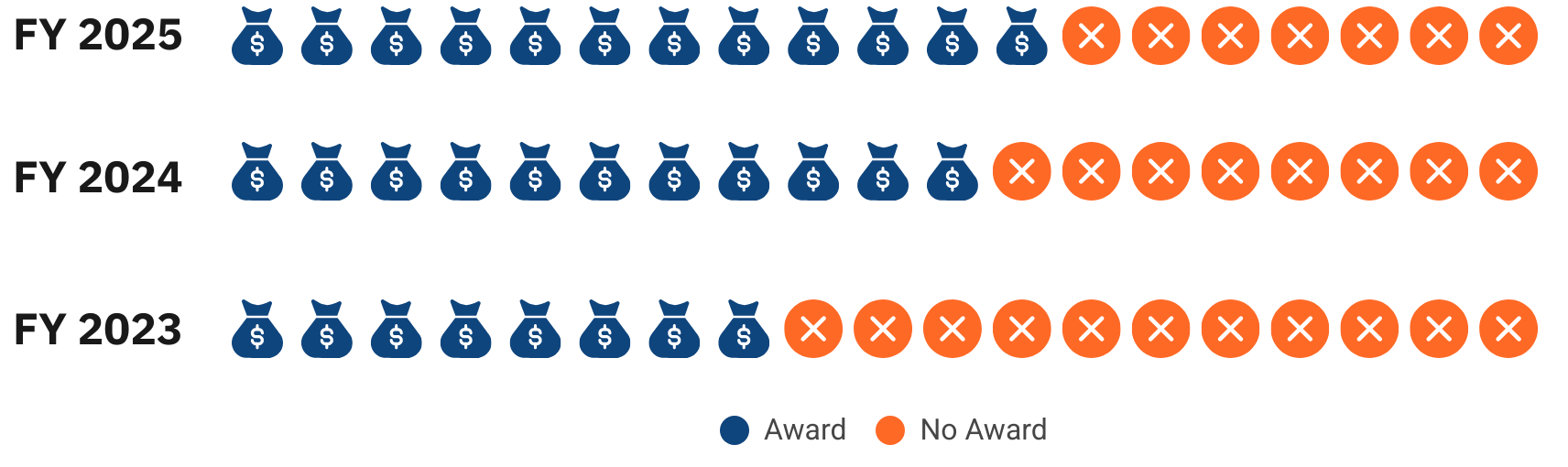
The use of one-time awards expanded over the review period. Eight of the 19 banks reported an OTA in FY 2023, compared with 12 in FY 2025 (Figure 2).
Figure 2. Number of S&P 500 Banks Granting One-Time Awards by Year, 2023 - 2025
Source: Glass Lewis Research. Note: Sample includes 19 S&P 500 banks, FY 2023-FY 2025.
More notably, aggregate OTA value across all recorded recipients increased from a little over $100 million to above $430 million, representing an approximate 311% increase (Figure 3).
Figure 3. Growth in S&P 500 Bank CEO Aggregate OTA Value, 2023 - 2025
Source: Glass Lewis Research. Note: Sample includes 19 S&P 500 banks, FY 2023-FY 2025.
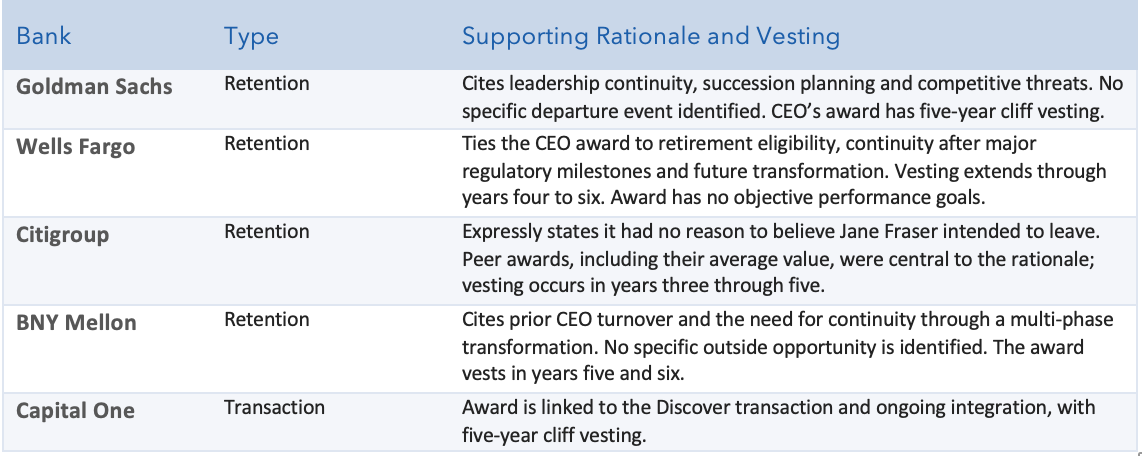
The FY 2025 total was also highly concentrated. Goldman Sachs, Wells Fargo, Citigroup, BNY Mellon and Capital One accounted for approximately $379 million, or nearly 87% of recorded FY 2025 OTA value. Whereas the total for Capital One incorporates multiple types of awards, including sign-on and transactional, awards at the other four companies were focused on retention (Table 1). Those distinctions matter: the data supports a broader conclusion about the growing effect of exceptional awards, but not every award reflects the same underlying governance concern.
Table 1. Rationales and Vesting for FY 2025 OTA Awards for S&P 500 Banks Representing Majority OTA Value
Source: Glass Lewis Research.
Goldman Sachs illustrates how these awards can extend beyond the CEO. In January 2025, the company granted retention RSUs valued at $80 million each to CEO David Solomon and president and COO John Waldron, both with five-year cliff vesting. The board framed the grants as supporting leadership continuity and succession planning. Together, the awards represented $160 million in aggregate grant value, although only Solomon’s award is reflected in the CEO-specific comparison below.
The bank results also sit within a wider increase in special awards. Glass Lewis research covering the 2026 proxy season found that S&P 500 companies granted approximately $2.7 billion in one-time awards, representing a 40.8% increase from the prior year. The average value of these awards increased by 22.7% to approximately $3.7 million. Although the average value of individual sign-on awards declined slightly, most other categories of one-time awards increased, partly reflecting the effect of awards at the upper end of the market.1
OTA Awards Explain Most of the CEO Pay Increase
At each of the five highlighted companies, the CEO-specific OTA was equivalent to approximately 83% to 93% of the CEO's year-over-year increase in reported compensation. The comparison does not represent a precise breakdown of Summary Compensation Table pay, but it illustrates how strongly the exceptional grants shaped the FY 2025 pay packages (Figure 4).
Figure 4. CEO Pay and CEO-Specific OTA for S&P 500 Banks Representing Majority OTA Value, 2024 - 2025
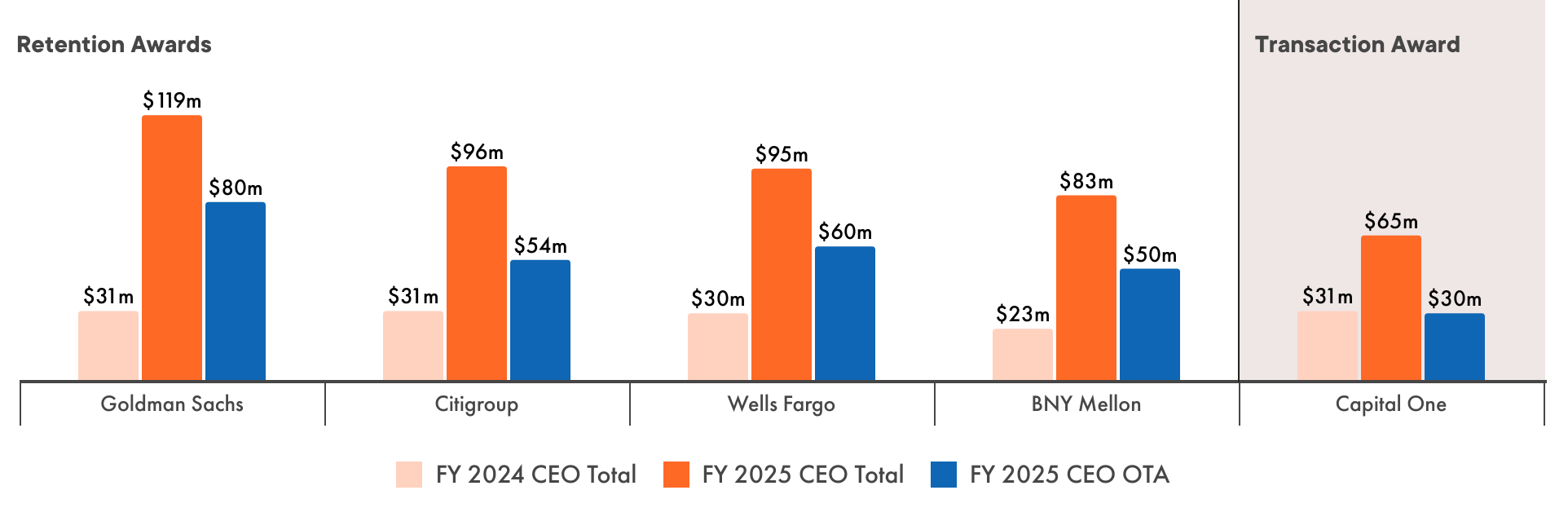
Source: Glass Lewis Research. Note: CEO OTA values reflect grant-date fair values of awards granted in FY 2025, rounded to the nearest million. Citi’s $60 million approved retention award opportunity included grants in both 2025 and 2026. The FY 2025 portion had a grant-date fair value of $53.6 million; additional options valued at $2 million were granted in January 2026 and are excluded above.
The pattern helps separate the underlying annual program from the headline total. Without the special awards, the FY 2025 figures would have remained much closer to the prior-year range.
The filings also demonstrate a circular benchmarking concern. Citi cited the prevalence and average value of recent peer CEO awards, while Wells Fargo and BNY referenced peer compensation developments and Goldman cited competitive market pressures. Once an exceptional award enters the peer data, it can become support for the next exceptional award, raising the benchmark even where the underlying retention threat is not clearly evidenced.
Citi’s FY 2025 award makes the cycle unusually easy to see. The company disclosed that 80% of its principal peers had granted special CEO awards during the preceding four years and that the average award value was approximately $60.65 million. Citi then approved an award with an approved value of $60 million. That does not mean the approved value was selected mechanically, but the near match is difficult to ignore. A practice initially presented as exceptional can start to look ordinary once enough peers have adopted it.
Investor Perspective and Broader Implications: What the Voting Results Indicate
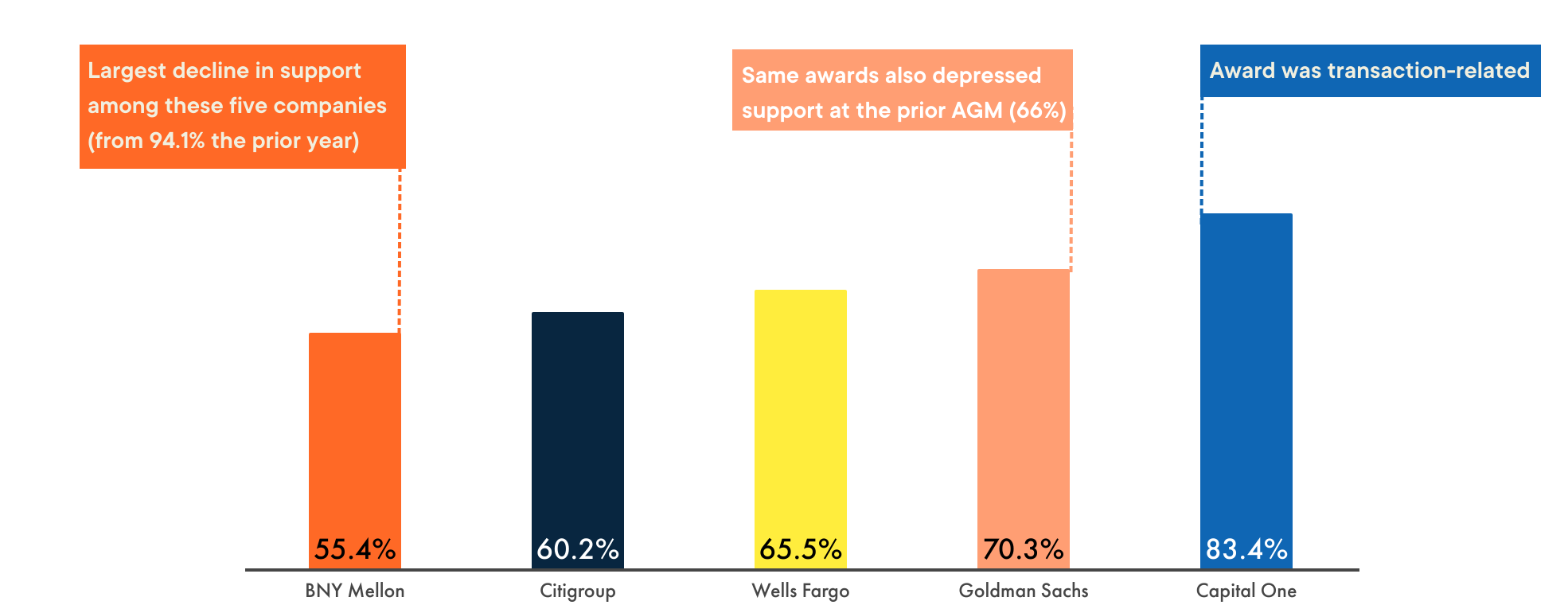
While say-on-pay proposals cover the executive compensation program as a whole, rather than a single award, 2026 voting results indicate that the bank OTA awards were a source of investor concern. Support ranged from approximately 55% at BNY Mellon to 83% at Capital One, compared with median S&P 500 support of approximately 93.5% for the period from January through June 2026. Citigroup, Wells Fargo and BNY Mellon each received support below 66%, while Goldman Sachs received approximately 70%.2
Figure 5. Summary of Say-on-Pay Support for S&P 500 Banks Representing Majority FY 2025 OTA Value
Source: Glass Lewis Research.
Capital One received the strongest support among the five companies. Its approximate 83% result remained below the broader S&P 500 median, but suggests that investors may have viewed an award tied to a defined transaction and integration period differently from awards based primarily on generalized retention concerns. By contrast, the four retention-focused cases each received support of approximately 70% or less.
The results do not establish that investors oppose one-time awards categorically. Across the S&P 500, one-time awards have increased without producing a corresponding decline in overall say-on-pay support. Rather, the bank results suggest that scrutiny becomes more pronounced when award values are exceptionally large, the evidence of an immediate retention threat is limited, or the award lacks objective performance conditions.
Notes and References
1 Glass Lewis. “2026 Proxy Season Global Trends Part 3: Executive Pay.” August 27, 2026. https://www.glasslewis.com/article/2026-proxy-season-global-trends-part-3-executive-pay
2 Company 2026 annual meeting voting results and Forms8-K for Goldman Sachs, Wells Fargo, Citigroup, BNY Mellon and Capital One.
Methodology Notes
- Sample reflects 19 S&P 500 banks, FY2023-FY2025, with a focus on the five companies that granted the largest awards in FY 2025.
- The analysis was intended as a focused case study of large-bank compensation practices, rather than a ranking of the 19 largest U.S. banks or a comprehensive review of every financial institution in the S&P 500.
- The S&P 500 served as the starting universe so that the companies would be broadly comparable in size, public-company reporting obligations and investor visibility.
- The sample focused primarily on companies operating as large banks, including diversified banks, regional banks, custody banks and other institutions with significant banking operations.
- Companies whose primary businesses were insurance, payment processing, mortgage REITs, consumer finance or investment management were generally outside the intended scope.
- The companies were retained consistently across FY 2023, FY 2024 and FY 2025 to support a year-over-year comparison of CEO compensation and one-time awards.