


Key Takeaways
- One-time awards require a case-by-case, context-specific approach to both award design and assessment, taking the wider pay program and strategic circumstances into account.
- Retention risk is often difficult for boards to contextualize, but can be communicated by identifying a specific triggering event, explaining why existing compensation was insufficient, and/or structuring the award around a meaningful service period.
- Investors may distinguish awards that are genuinely retentive from those that are demonstrably necessary: the former depends primarily on vesting design, while the latter rests on the rationale and proportionality of the award in the context of existing incentives.
- If an unadjusted total pay figure that reflects both ordinary annual compensation and one-off awards is cited as evidence of the prevailing market rate, an award initially characterized as exceptional can influence subsequent benchmarking decisions.
- Reporting both average and median outcomes, identifying the effect of unusually large awards and distinguishing recurring pay from one-off grants provides a clearer view of whether compensation levels increased broadly or only at the top of the sample.
Given their exceptional nature and cost to shareholders, one-time awards (OTAs) require a case-by-case, context-specific approach to both award design and assessment that takes the company’s wider pay program and strategic circumstances into account. Moreover, the impact of an OTA may extend beyond the company that granted it; though nominally exceptional, OTAs can end up setting the bar for peer companies.
In recent years, large U.S. banks have increasingly granted significant OTAs to their CEOs, primarily for retention, leadership continuity and transaction-related considerations. During fiscal year 2025, 12 of the 19 S&P 500 banks granted OTAs, with just five of those awards accounting for nearly 87% of recorded FY 2025 OTA value in the sector.
Our previous article examined the growing use and value of one-time awards among large banks.1 In this article, we explore the implications for award setting and analysis and, separately, for benchmarking.
Implications for Award Setting and Analysis
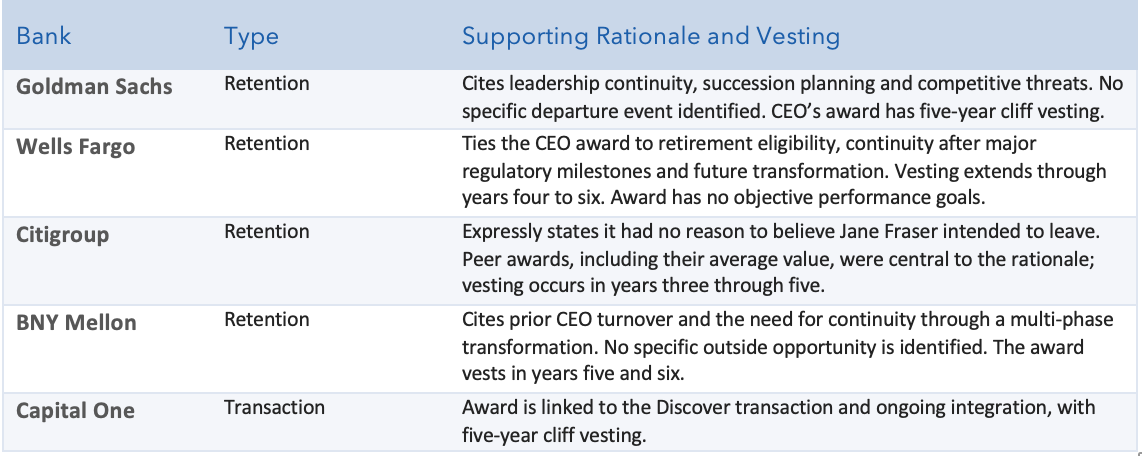
Retention is the primary focus of this analysis because four of the five highlighted CEO awards were expressly intended to support leadership continuity (see Table 1). For those awards, the key questions concern the credibility of the retention risk, the retention value already provided by existing compensation and whether the award’s size and structure are proportionate to the stated need. Other award types require a different focus. Transaction awards should be assessed against the relevant event and the executive’s role in completing it, while sign-on awards generally require consideration of compensation forfeited upon joining the company.
Table 1. Rationales and Vesting for FY 2025 OTA Awards for S&P 500 Banks Representing Majority OTA Value
Source: Glass Lewis Research.
Award Rationales
This analysis begins with the circumstances giving rise to the award: whether the company identifies a transaction, succession process, transformation or credible competitive threat that creates a defined need for continuity. A long vesting period may establish that an award is capable of retaining the executive, but it does not independently establish that the award was necessary or that its value was proportionate to the underlying risk.
The strongest rationales connect the award to a defined business need and require service through that period. That is typically easier for certain types of awards – such as those tied to a specific transaction, or a new hiring – than others. Ultimately, the ability for a company to fully contextualize retention risk is limited, given concerns surrounding the potential competitive concerns that such disclosure might instigate and the incomplete picture the board itself may have on such risks. However, retention risk can still be communicated by identifying a specific triggering event, explaining why existing compensation was insufficient, or structuring the award around a meaningful service period. General references to competition for talent or peer practices are less compelling, particularly when no actual departure risk is identified.
In this case, Capital One identifies the clearest triggering event, the Discover transaction (Table 1 above). Among the retention-focused awards, Wells Fargo and BNY provide comparatively concrete continuity narratives tied to regulatory progress or a multi-stage transformation. Goldman Sachs identifies succession planning and leadership stability, but only cites generalized competitive pressure.
Notably, none of the retention-centric disclosures identifies a competing offer or a stated intention to depart. Citi goes further and expressly says it had no reason to believe Fraser intended to leave. The awards may still support continuity, but the public record more clearly establishes the boards’ desire to retain the executives than the existence of an immediate risk that they would leave.
Current Alignment of Interests
Existing equity is also relevant. An executive may already hold substantial unvested annual awards, face ownership requirements and participate in future annual incentive opportunities that provide substantial reasons to remain. Where these arrangements already represent meaningful retention value, the company’s explanation should address the incremental gap the special award is intended to fill. Among the reviewed companies, the disclosures generally explain why continuity is important, but provide less detail regarding why the existing compensation program was insufficient or how the award amount was calibrated.
Structural Safeguards
Award design matters too. Five- or six-year vesting creates a real service incentive and is broadly consistent with the Council of Institutional Investors' view that long-term compensation should operate over at least five years.2 Safeguards like forfeiture upon voluntary departure and continued-service requirements further support the stated retention purpose.
Where practicable, performance conditions can further connect the award to the business objective underlying the grant. Stock options add exposure to share-price appreciation, but they are not the same as an award with pre-established operating or relative performance conditions. Wells Fargo, for example, disclosed that it considered performance shares, but decided that setting goals over the extended period would be difficult. That explanation is understandable, though it leaves shareholders with less protection against payment for market-driven gains.
Investors may nevertheless distinguish between an award that is genuinely retentive and one that is demonstrably necessary: the former is primarily a question of vesting design, while the latter depends on the company’s rationale, existing incentives and the proportionality of the award. Glass Lewis similarly evaluates necessity, the adequacy of existing awards, quantum, structure, future service and performance conditions, and the interaction with regular compensation.3
Implications for Benchmarking Against the Broader Compensation Market
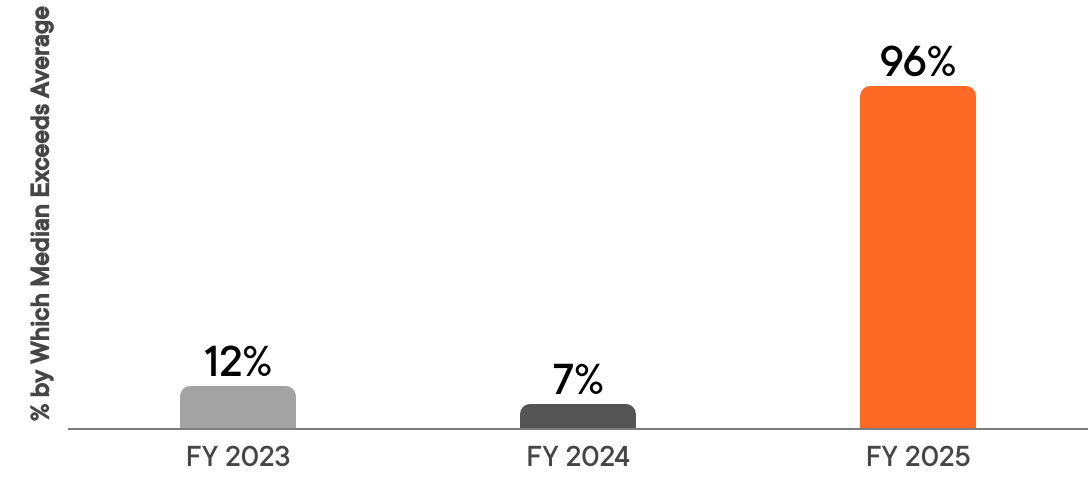
In our prior article, we discussed how a handful of large one-time awards contributed to a substantial increase in average CEO compensation among S&P 500 banks, while median compensation remained relatively stable. The difference between average and median pay is not itself new or unusual. It is common for average CEO pay to exceed the median because a few especially large packages can pull the average upward. What stands out here is just how wide that gap became in FY 2025 (Figure 1).
Figure 1. Gap Between Average and Median CEO Pay in S&P 500 Bank Sector, 2023-2025
Source: Glass Lewis Research.
In FY 2023, average CEO compensation was approximately 12% above the median. In FY 2024, it was approximately 7% higher. By FY 2025, the average was approximately 96% above the median. The average has historically exceeded the median, but the gap widened substantially in FY 2025, primarily due to a small number of one-time awards.
Such a high ratio is notable because exceptional awards can impact benchmarking data even though they do not form part of the recurring compensation program. An unadjusted average may consequently reflect both ordinary annual compensation and awards intended to address one-off circumstances. If the resulting figure is then cited as evidence of the prevailing market rate, an award initially characterized as exceptional can influence subsequent compensation decisions.
A similar concentration at the upper end of the market has been observed outside the United States. Glass Lewis research on the S&P/ASX 100 found that growth in variable incentive opportunity was concentrated among the highest-paying companies, several of which relied on international or U.S. comparators.4 Although the Australian analysis excluded one-time awards, both studies illustrate how a relatively small number of companies can pull market-level compensation measures upward without a comparable shift across the broader sample.
Peer Group Construction and Disclosure
This does not make market benchmarking inherently inappropriate. It does, however, make the composition of the comparison important. SEC staff has previously emphasized that when benchmarking materially affects compensation decisions, companies should identify the peers used, explain the basis for selecting the peer group, and describe the relationship between actual compensation and the benchmarking data.5 Academic research has also found that compensation peer groups may be constructed in a manner that creates an upward bias in CEO pay.6
Reporting both average and median outcomes, identifying the effect of unusually large awards and distinguishing recurring pay from transaction, recruitment or retention grants provides a clearer view of whether compensation levels increased broadly or only at the top of the sample. However, while disclosure helps investors understand the inputs used in compensation decisions, it does not necessarily eliminate the potential for an upward trend when companies repeatedly benchmark against an already rising market.
Conclusion
The FY 2025 bank results reflect two distinct developments. First, a small group of companies granted exceptionally large awards in response to stated retention, succession, transformation or transaction-related considerations. Second, those awards materially changed the resulting market data, causing average CEO compensation to rise much more sharply than the median.
The voting results suggest that investors differentiated among these arrangements rather than rejecting one-time awards categorically. Capital One’s transaction-related award received comparatively stronger support, while the four retention-focused programs generated substantially higher opposition. Although say-on-pay outcomes reflect the full compensation program, the concentration of relatively high voting opposition to these proposals indicates that OTAs – and particularly the questions of award necessity, value, structure and disclosure – remained relevant to investors.
More broadly, the concentration of these awards and the resulting divergence between average and median pay show how awards granted for different company-specific purposes can collectively influence the market data considered by other companies.
Notes and References
1 Fassbender, Hannah. “Bank CEO Pay on the S&P 500: How One-Time Awards Impact Compensation and Benchmarking.” Glass Lewis. October 22, 2026. https://www.glasslewis.com/article/bank-ceo-pay-on-the-s-p-500-how-one-time-awards-impact-compensation-and-benchmarking
2 Council of Institutional Investors. “Policies on Corporate Governance: Executive Compensation.” https://www.cii.org/files/ciicorporategovernancepolicies/09_17_19_corp_gov_policies.pdf
3 Glass Lewis. “2026 Benchmark Policy Guidelines — United States, pp. 51-52 and 59.” https://resources.glasslewis.com/hubfs/2026%20Guidelines/Benchmark/Benchmark%20Policy%20Guidelines%202026%20-%20United%20States.pdf
4 Bielawska, Alice. “The Upward Drift in S&P/ASX 100 CEOs’ Variable Incentive Opportunity.” Glass Lewis. July 14, 2026. https://www.glasslewis.com/article/the-upward-drift-in-s-p-asx-100-ceos-variable-incentive-opportunity
5 White, John. “Executive Compensation Disclosure: Observations on Year Two and a Look Forward.” Securities and Exchange Commission. October 21, 2008. https://www.sec.gov/newsroom/speeches-statements/spch102108jww-executive-compensation-disclosure-observations-year-two-look-forward-changing-landscape-2009
6 Bizjak, Lemmon and Nguyen. “Are All CEOs Above Average? An Empirical Analysis of Compensation Peer Groups and Pay Design.” Journal of Financial Economics (2011). https://www.sciencedirect.com/science/article/abs/pii/S0304405X11000407