


Key Takeaways
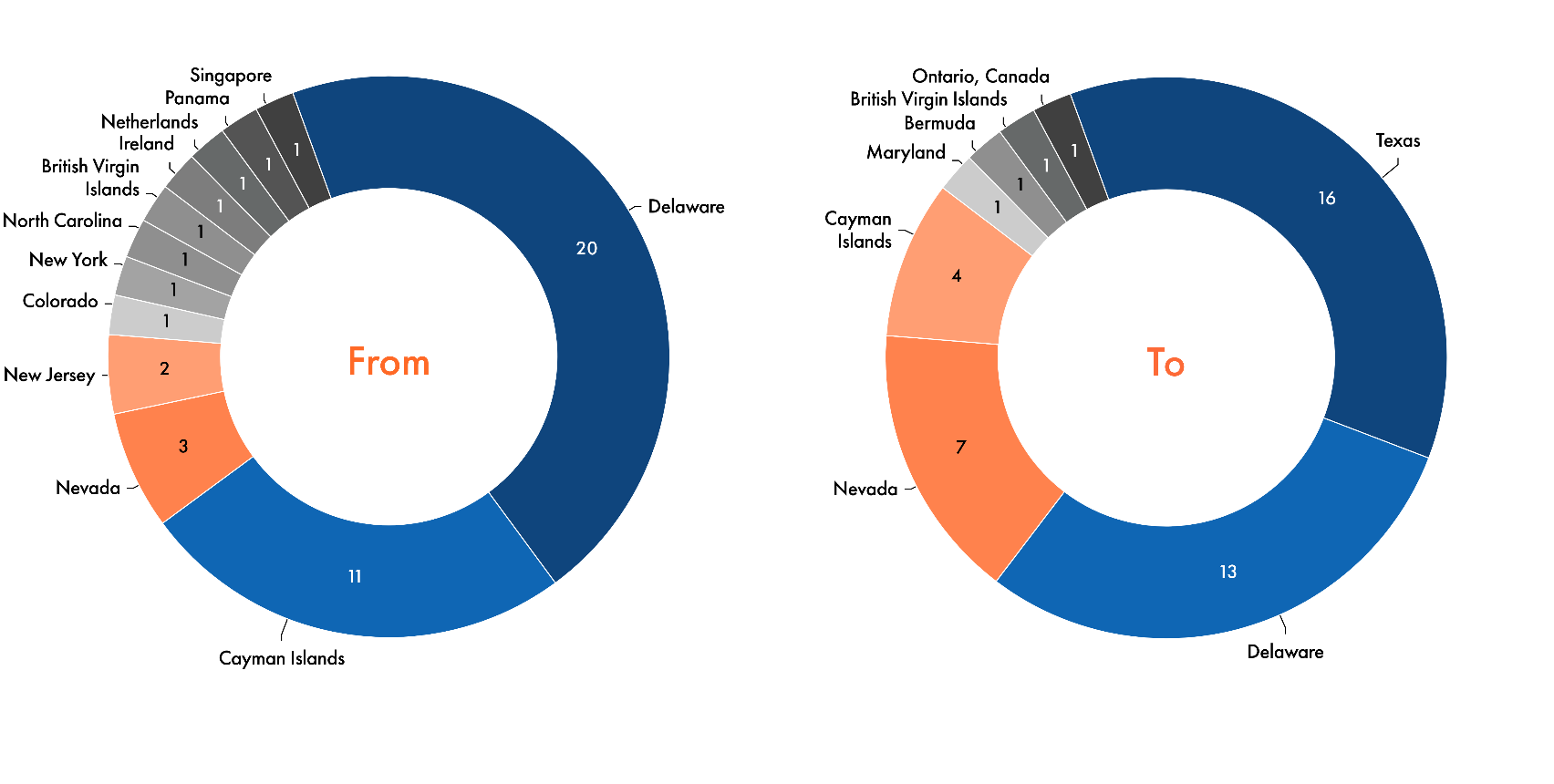
- Reincorporation proposals marked a four-year high during the 2026 proxy season as 44 U.S. companies sought to move to a different jurisdiction (up from 28 in 2025, and 17 in 2024).
- 16 of the 44 companies proposed reincorporating to Texas (compared to two in 2025), which has recently made sweeping changes to its corporate law.
- Delaware experienced the most movement, with 20 (up from 18 in 2025) of the 44 proposing to reincorporate away from Delaware, while 13 (up from 8 in 2025) companies proposed reincorporating to Delaware.
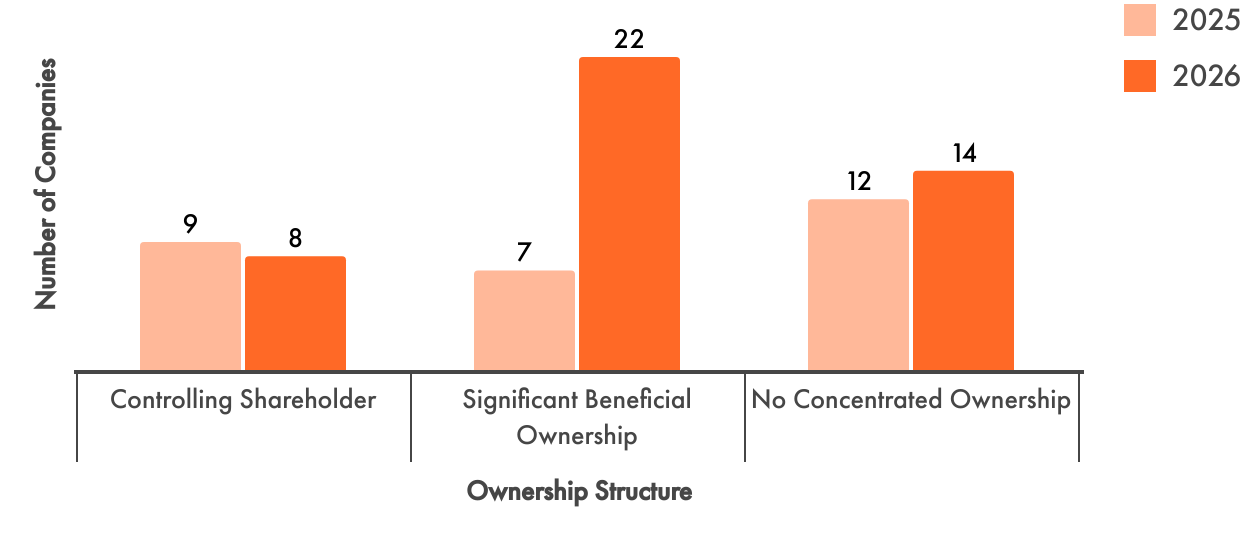
- Consistent with 2025, reincorporation proposals remain particularly common among companies with significant/controlling shareholders. Of the 44 companies, eight (down from nine in 2025) were controlled and 22 (up from seven in 2025) had shareholders with significant beneficial ownership.
Reincorporation proposals have been prominent in each of the past two proxy seasons, due to fears of DEXIT: speculation that Delaware would experience an exodus of companies as a result of certain court decisions and the increased risk of litigation.1 With several states jockeying for position, Texas has emerged as a preferred destination after recent amendments to its corporate law. Meanwhile, investors appear to be broadly supportive of reincorporation proposals when boards provide a cogent rationale for the move, while applying increased scrutiny to how these changes of jurisdiction impact their rights as shareholders.
Increased Reincorporation Proposals and the Emergence of Leading Destinations
The 2025 season saw a significant uptick (71%) in the number of companies looking to reincorporate to different state jurisdictions.2 Specifically, Delaware, Nevada and Texas emerged as the top competitors after amending their corporate laws to better incentivize incorporations. Following these amendments, last year the most common destination shifted for the first time from Delaware to Nevada.
This season, the number of companies looking to move further increased by an additional 51.7%, with Glass Lewis evaluating 44 different proposals, of which 43 went to a vote. Like last year, Delaware, Nevada and Texas were the states companies most commonly sought to reincorporate to. Of the three, however, Texas became the top destination for the 2026 season (Figure 1).
Figure 1. U.S. Company Reincorporation Proposals in Proxy Season 2026
Source: Glass Lewis Research.
Texas experienced a significant increase in the number of companies looking to move there, with 16 of the 44 evaluated proposals requesting Texas as their new jurisdiction, compared to just two last season. Meanwhile, 13 sought to move to Delaware, and seven proposed incorporating to Nevada, compared to eight and 14 in 2025, respectively. Notably, nine of the Delaware-bound moves involved shell companies looking to reincorporate in connection with a business combination, rather than operational companies changing their jurisdiction.
Ownership Structure: Companies with Major Shareholders Were More Likely to Move
This year, reincorporation proposals were particularly common among companies with significant or controlling shareholders (Figure 2). More than two-thirds (68%) of U.S. reincorporations in proxy season 2026 involved companies that were either controlled (eight, compared to nine in 2025) or had shareholders with significant beneficial ownership (22, compared to seven in 2025). That’s up from 55% during proxy season 2025.
Figure 2. Reincorporation Proposals by Ownership Structure in Proxy Season 2026
Source: Glass Lewis Research.
The Appeal of Recent Texas Business Organization Code Amendments
This increased migration of companies moving to Texas is likely driven by the state’s recent amendments to its Texas Business Organization Code (TBOC).3 With a number of provisions viewed as management friendly,4 these amendments have helped establish the state as a favored jurisdiction.
Among other provisions, the new TBOC amendments include jury trial waivers, as well as minimum ownership thresholds for books and records requests, derivative lawsuits, and shareholders’ abilities to submit proposals for consideration at annual meetings. These aspects of the code are largely viewed as restrictive to shareholder rights.5 In addition, other notable features of Texas’ corporate code include the codification of a business judgement rule and specialized business courts designed to promote predictability for corporate decisions.
In their published rationales, all the companies cited the legal environment, favoring Texas’s statutory approach and codified business judgement rule over Delaware’s judicial approach to create a more stable and predictable environment for business decisions. In addition, 10 companies noted they had significant business operations in the state, with eight of the companies’ headquarters located there. Furthermore, seven companies looking to reincorporate from Delaware cited cost savings regarding franchise tax obligations and fees to the state of Delaware.
Companies can choose which TBOC provisions to adopt in their articles and bylaws. While not all of the Texas-bound companies included the TBOC provisions that are most restrictive to shareholder rights in their proposed governing documents, the vast majority opted into at least one or more of them:
- 11 of the 16 companies (68.8%) included a threshold for shareholders to pursue derivative litigation.
- Seven (43.8%) included a threshold for shareholders to submit proposals.
- 13 (81.3%) provided for jury trial waivers.
Companies do have the option to opt out of these provisions, however, issuers may later amend their governing documents to implement them, possibly leaving shareholders exposed to these limits on their rights in the future. Notably, ArcBest Corporation was the only company to expressly opt out of certain provisions in their proposed governing documents, including the thresholds for shareholders to pursue derivative action and to submit shareholder proposals. On the other end of the spectrum, five companies, including Dell Technologies, elected to implement all the rights-restrictive TBOC provisions.
As demonstrated in the examples below, many companies fell somewhere in between, with varying rationales and approaches to the TBOC amendments. Some did not adopt the rights-restrictive amendments, but failed to expressly opt out in their governing documents (as observed at ArcBest). Others implemented only select TBOC amendments, or modified versions that appear less restrictive.
Notable Texas-Bound Moves: ExxonMobil, Natural Gas Services, Texas Capital Bancshares
ExxonMobil
One of the largest companies to reincorporate to Texas this season was ExxonMobil. The company cited its Texas headquarters and legal environment as the main points of rationale, stating that in addition to most of the company’s senior executives and all corporate functions and businesses being located in the state, the board also, “believes that Texas is deliberate in offering business a common-sense regulatory environment that fosters innovation, job creation, and economic growth” and that, “the Texas legislature and courts are aware of and value ExxonMobil’s significant and long-standing contributions to the economy and generally have a vested interest in ensuring [the] company and industry continue playing a vital role in supporting global economic growth.” The board further stated that among other factors, the board considered “Texas’ statute-oriented approach to corporate law, which provides a degree of legal and regulatory certainty in corporate decision-making that can benefit long-term shareholder value.”6
Exxon did not opt into any of the more rights-restrictive TBOC amendments, specifically disclosing that it “is not adopting any elective provisions of the Texas corporate statute that could be viewed as weakening shareholder rights as compared to New Jersey law.”7 The proposal received support from approximately 71% of votes cast, satisfying New Jersey’s requisite vote of a majority of votes cast, as well as the higher threshold of a majority of shares outstanding (as is Delaware’s requisite vote) with approximately 53% support.
Natural Gas Services
Natural Gas Services requested shareholder approval to reincorporate from Colorado to Texas, citing improved governance. Specifically, the move would enable the company to remove certain negative governance provisions in its Colorado governing documents that would otherwise require approval from 80% of shares outstanding. The new governing documents in connection with the reincorporation included substantially improved governance practices, including the ability to remove directors with or without cause by approval of a majority of shares outstanding, and elimination of the board’s classified structure. In addition, like Exxon, the company cited its Texas headquarters and legal environment.
Natural Gas Services took a mixed approach to the rights-restricting TBOC provisions. It did not implement the minimum thresholds for derivative suits and to submit shareholder proposals, specifically stating that the board elected “not to opt into or incorporate those elective corporate governance provisions under the TBOC which, in the board’s judgement, could be used to limit shareholders’ rights.”8 However, the company did not expressly opt out of them in their governing documents. The company did opt in to the jury trial waiver; given the high support for the proposal (87.4% support), shareholders may have taken the view that this feature was sufficiently offset by the numerous positive governance changes.
Texas Capital Bancshares
Texas Capital Bancshares sought shareholder approval this season to move from Delaware to Texas. The Texas-headquartered company cited its business operations, legal environment, and cost savings from Delaware’s franchise tax as primary considerations for the reincorporation.8 The bank did not implement the TBOC threshold for shareholders to submit shareholder proposals outright but rather opted to hold an advisory vote on raising the shareholder proposals ownership threshold to 3%, which shareholders overwhelmingly rejected with only 12.4% support. In addition, the company adopted a reduced threshold of 1% (vs. the TBOC standard 3%) for shareholders to pursue a derivative action. While the company took a more measured approach with the reduced threshold and advisory vote, it appears it was not enough to mitigate shareholder concerns, as the reincorporation proposal failed with only 43.4% support.
Shareholder Voting on Reincorporations
On average, the 16 companies seeking a move to Texas received 72.2% support from shareholders. That compares with 76.6% for companies moving to Nevada, 96.6% for Delaware, and 83.2% overall.
The reincorporation proposal at Texas Capital Bancshares was one of three that did not achieve the requisite approval from shareholders. All three proposals involved moves to Texas. Notably, five of the 16 Texas reincorporation proposals were at companies that had controlling or significant beneficial owners; while all were approved, four of the five proposals would have failed if the vote were limited to unaffiliated shareholders.
These outcomes indicate that with DEXIT emerging as a real phenomenon, and amendments to the state’s corporate law helping to solidify Texas’ standing as a desirable jurisdiction, investors are placing increased scrutiny on how reincorporations affect their rights as shareholders, and the governance practices of investee companies. While this trend is likely to continue, companies with preexisting ties to Texas largely dominated the push to the Lone Star State. As we move into 2027, the question becomes whether this sustained trend will remain limited to companies with significant beneficial owners and pre-existing ties to destination states, or extend more broadly to other companies. Regardless, companies looking to reincorporate will continue to be closely monitored by shareholders.
Notes and References
1 Sam Nolledo, Sarah Wenger and Aaron Wendt. “The State of US Reincorporation in 2025: The Growing Threat and Reality of ‘DEXIT.’” Glass Lewis. October 9, 2025. https://www.glasslewis.com/article/state-of-us-reincorporation-2025-growing-threat-reality-dexit
See also Nolledo, Wenger and Wendt, “The State of US Reincorporation, Part II: Post-Proxy Season 2025.” Glass Lewis. March 25, 2026. https://www.glasslewis.com/article/the-state-of-u-s-reincorporations-part-ii-post-proxy-season-2025
2 Ibid.
3 Texas Secretary of State. Information on the Texas Business Organizations Code. https://www.sos.state.tx.us/corp/boc.shtml
4 Andrew Lucano and James Dorough-Lewis Jr. “Texas Adopts Business-Friendly Amendments to Its Corporate Code—A Response to Delaware?” Seyfarth. June 2, 2025. https://www.seyfarth.com/news-insights/texas-adopts-business-friendly-amendments-to-its-corporate-codea-response-to-delaware.html
5 Ibid.
6 Press Release. “ExxonMobil Board Unanimously Recommends Redomiciling the Company from New Jersey to Texas.” ExxonMobil Corporation. March 10, 2026. https://www.sec.gov/Archives/edgar/data/34088/000119312526099413/d10491ddefa14a.htm
7 Ibid.
8 Natural Gas Services. Notice of 2026 Annual Meeting of Shareholders and Proxy Statement. April 28, 2026. https://www.sec.gov/Archives/edgar/data/1084991/000108499126000032/ngs-20260428.htm
9 Texas Capital Bancshares. Notice of 2026 Annual Meeting of Shareholders and Proxy Statement. March 12, 2026. https://www.sec.gov/Archives/edgar/data/1077428/000107742826000040/tcbi-20260309.htm