

Key Takeaways
- Respondents to Glass Lewis’ Stewardship Survey who use an external stewardship provider say they mostly do so as “capacity multipliers,” leveraging external resources and expertise to pursue common goals.
- Challenges faced by respondents overseeing outsourced engagement revolve around data-related issues, particularly collecting information from managers and normalizing the data and formats.
- When asked if ESG or anti-ESG positions influenced their stewardship priorities, respondents said the issue has not led to wholesale reprioritization, but is of marginal influence.
Communicating how investors structure, resource, and execute stewardship in an increasingly complex operating environment was the primary aim of this year’s Investment Stewardship Survey Report.1 This article summarizes some of the more forward-looking sentiments of respondents, specifically on their use of engagement-providers, their oversight of outsourced stewardship, and the implications of a diverging market landscape.
Engagement Providers Act as Capacity Multipliers for Investors
Three out of four respondents do not use external engagement providers, while almost half of asset owners do. Asset managers and respondents with larger investment teams are less likely to do so, indicating how different operating models, culture and team size influence the perceived need and benefit here.
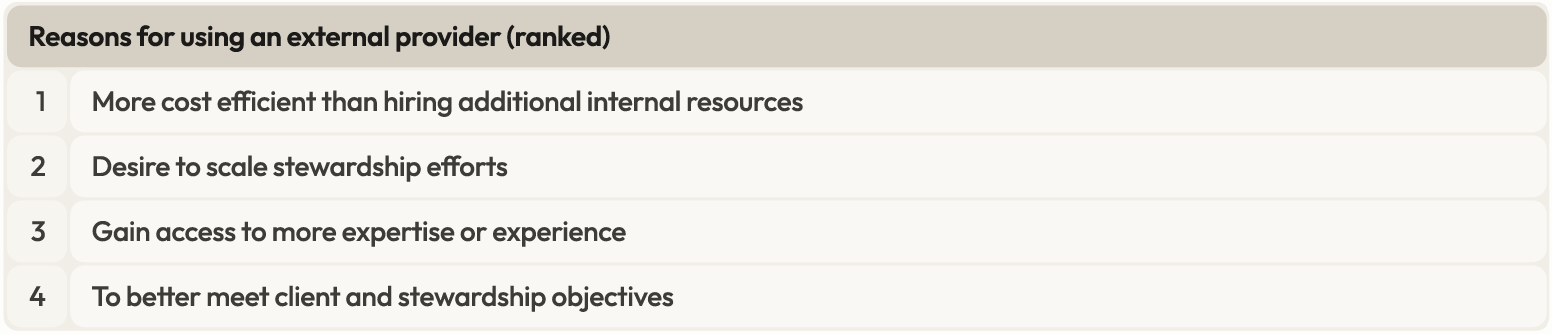
Among those who use an external provider, the top reasons are explicitly pragmatic (Table 1), suggesting that utility comes primarily from viewing these providers as “capacity multipliers,” leveraging external resources and expertise to pursue common goals.
Table 1. Ordinal Ranking of Why Respondents Use External Engagement Providers
Source: The 2026 Glass Lewis Stewardship Survey Report.
When choosing an engagement provider, the most important selection criteria center on the provider’s ability to support a broad range of engagement types, alongside the strength of their processes, resources and expertise (Table 2). This highlights the preference for partners that can deliver both thematic flexibility and operational credibility.
Table 2. Respondents' Top Three Criteria When Selecting and Engagement Provider

Source: The 2026 Glass Lewis Stewardship Survey Report.
Asset Owners Want Greater Oversight of Outsourced Stewardship
Most asset owners with externally managed assets have an interest in monitoring and reporting on stewardship activities carried out on their behalf, reflecting growing expectations for transparency and oversight.
When we asked interested respondents to rank a set of challenges to improving this process, the most significant ones centered around data-related issues, particularly collecting information from managers and normalizing the data and formats (Table 3).
Table 3. Respondents’ Ranking of Challenges to Improving Oversight Over Outsourced Engagement

Source: The 2026 Glass Lewis Stewardship Survey Report. Note: * Mean rank shows the average position each alternative received across respondents. A lower number means a higher preference. Comma denotes decimal point.
These challenges highlight differing investor approaches to stewardship and the lack of standardization in the market, which in turn leads to operational complexity for asset owners in translating stewardship activity into consistent, decision-useful insights.
The Implications of a Changing and Diverging Market Landscape
We asked investors to what extent political, regulatory, or public debates around ESG or anti-ESG positions had influenced their stewardship priorities in the past 12 months. We found that the debate is present, but it has not prompted wholesale reprioritization. Instead, the debate generally registers as a marginal influence (Figure 1).
Stewardship priorities are generally influenced to some degree, with a significant majority of respondents reporting slight to modest impact. Smaller organizations are more likely to indicate that these debates have had little or no influence on their stewardship focus, indicating greater insulation from external pressure.
The results did not show any evident regional differences between Europe and North America.2 This contrasts with the regional differences we saw in prioritization of engagement topics and could indicate how different regional and institutional contexts shape practices over time.
Figure 1. Summary of Respondents’ Stewardship Priorities Being Influenced by the ESG vs. Anti-ESG Debate

Source: The 2026 Glass Lewis Stewardship Survey Report.
In their comments, respondents noted a reduction in activity with U.S. companies, a shift in focus toward more bilateral dialogues in comparison to collaborative engagements, and that stewardship principles and priorities remain largely unchanged notwithstanding the change in the engagement environment. As one respondent put it:
"We have not scaled back on our stewardship practices or engagement efforts, we remain steady even though the pendulum swings. However, we of course take the current anti-ESG movement into considerations and prepare engagements and discussion accordingly, depending on who we engage with."
Overall, the findings indicate that while external ESG discourse impacts on respondents’ stewardship practices, so far it has tended to shape priorities at the margins rather than drive fundamental change.
For more insights on the current state of investment stewardship, download the 2026 Glass Lewis Stewardship Survey Report.
Notes and References
1 Glass Lewis. The Glass Lewis Stewardship Survey Report. March 2026. https://grow.glasslewis.com/global-investment-stewardship-survey-insights-for-investors.
2 For additional details regarding regional differences, see Nillson, R. "The Current Strategic Landscape for Investment Stewardship." Glass Lewis. May 7, 2026. https://www.glasslewis.com/article/current-strategic-landscape-investment-stewardship.