


Key Takeaways
- Glass Lewis 2026 Investment Stewardship Survey respondents report that their engagement priorities are anchored in climate change and governance.
- Regional patterns show European investors emphasizing sustainability topics more strongly, while North American investors place greater weight on traditional governance issues.
- A hybrid approach to stewardship has become the dominant operating model, balancing broad baseline expectations with targeted company-specific engagement.
- Engagement prioritization reflects a multi-factor approach, with policy alignment most common but investors also weighing factors such as materiality, ownership levels, and resource capacity.
- Efforts to improve stewardship quality are framed around stronger links to investment decision-making, better prioritization and research, credible escalation strategies, and more effective outcomes reporting.
Earlier this year, Glass Lewis published its inaugural 2026 Investment Stewardship Survey Report.1 With respondents from asset managers and asset owners across Europe, North America, and Asia-Pacific the report features insights on how investors structure, resource, and execute stewardship in an increasingly complex operating environment. Based on the survey findings, this article presents today's strategic landscape for investment stewardship, including current engagement priorities, operational approaches, criteria for prioritization of engagement themes, and key areas of improvement.
Engagement Priorities Converge on Climate and Governance, but Diverge by Region
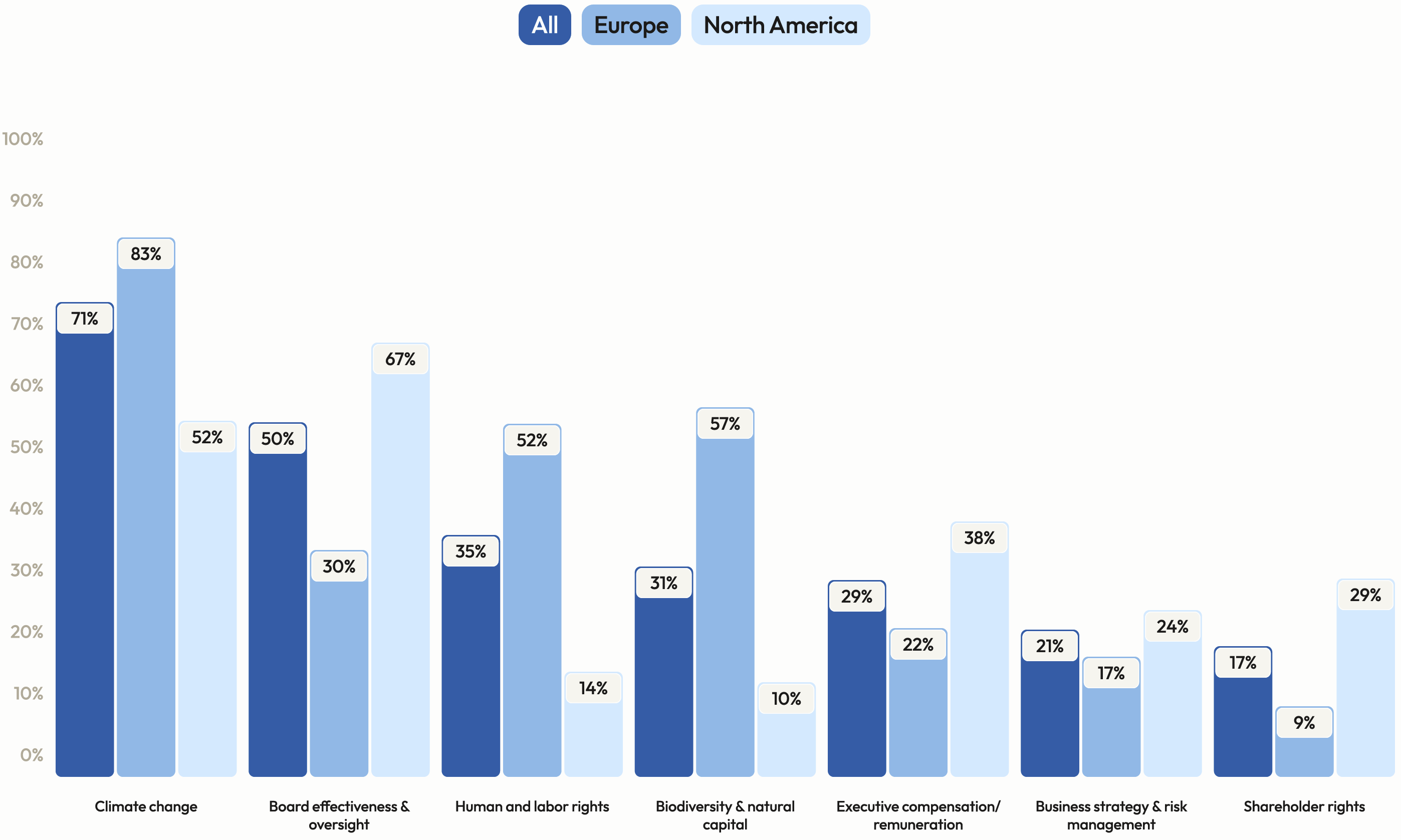
Survey respondents’ engagement activity most commonly covers climate change (71%) and board effectiveness and oversight (50%), reinforcing the central role these topics have in stewardship agendas (Figure 1). Regional differences appear with European investors relatively more focused on sustainability topics (i.e., climate change, human and labor rights, and biodiversity), vs. North American investors who put more emphasis on traditional corporate governance topics (i.e., board effectiveness and oversight, executive compensation and shareholder rights).
Figure 1. Comparison of Engagement Priorities by Region
Source: The 2026 Glass Lewis Stewardship Survey Report.
Aside from the regional differences, social topics seem to gain greater prominence among respondents that have the scale and resources to address them more systematically. Other topics highlighted by respondents covered toxics and chemicals, Indigenous relations, general governance and disclosure/transparency practices.
One participant also pointed out that:
"We engage based on what is material to specific industries or portfolio holdings, or what is material to our portfolios overall."
Overall, the findings suggest that while climate and governance remain foundational stewardship topics, and investors might establish specific thematic priorities, the coverage is broad and, more often than not, situational.
Hybrid Stewardship Is the Norm, but It Increases Operational Complexity
When asked to describe their organization’s stewardship philosophy and allocation of resources across investees and performed activities, close to two-thirds of investors report using a hybrid approach, which combines baseline market expectations with more targeted and intensive company-specific engagements. The remaining respondents were evenly split between generalized and specialized approaches to stewardship (Table 1).
Table 1. Respondents’ Organizational Approach to Stewardship

Source: The 2026 Glass Lewis Stewardship Survey Report.
As one respondent put it:
“The hybrid approach (from the point of view of the companies) we address bilaterally, but also in terms of when we enter multi-stakeholder engagements, and is highly contingent on asset class. For private markets, we almost exclusively engage our asset managers to do stewardship in line with our interests.”
The choice here naturally depends on investors’ profiles. With most respondents diversified across hundreds or thousands of assets, the hybrid approach requires relatively more effort to analyze holdings, set stewardship priorities, and track and report on progress. Each of these tasks were cited as being particularly resource-intensive when we separately asked investors to rank the amount of time they spend on administrative tasks that empower operational efficiency. Overall, the findings suggest that stewardship models look to balance consistency with selectivity, to enable scale while aiming for operational efficiency.
Engagement Prioritization Reflects a Combination of Criteria
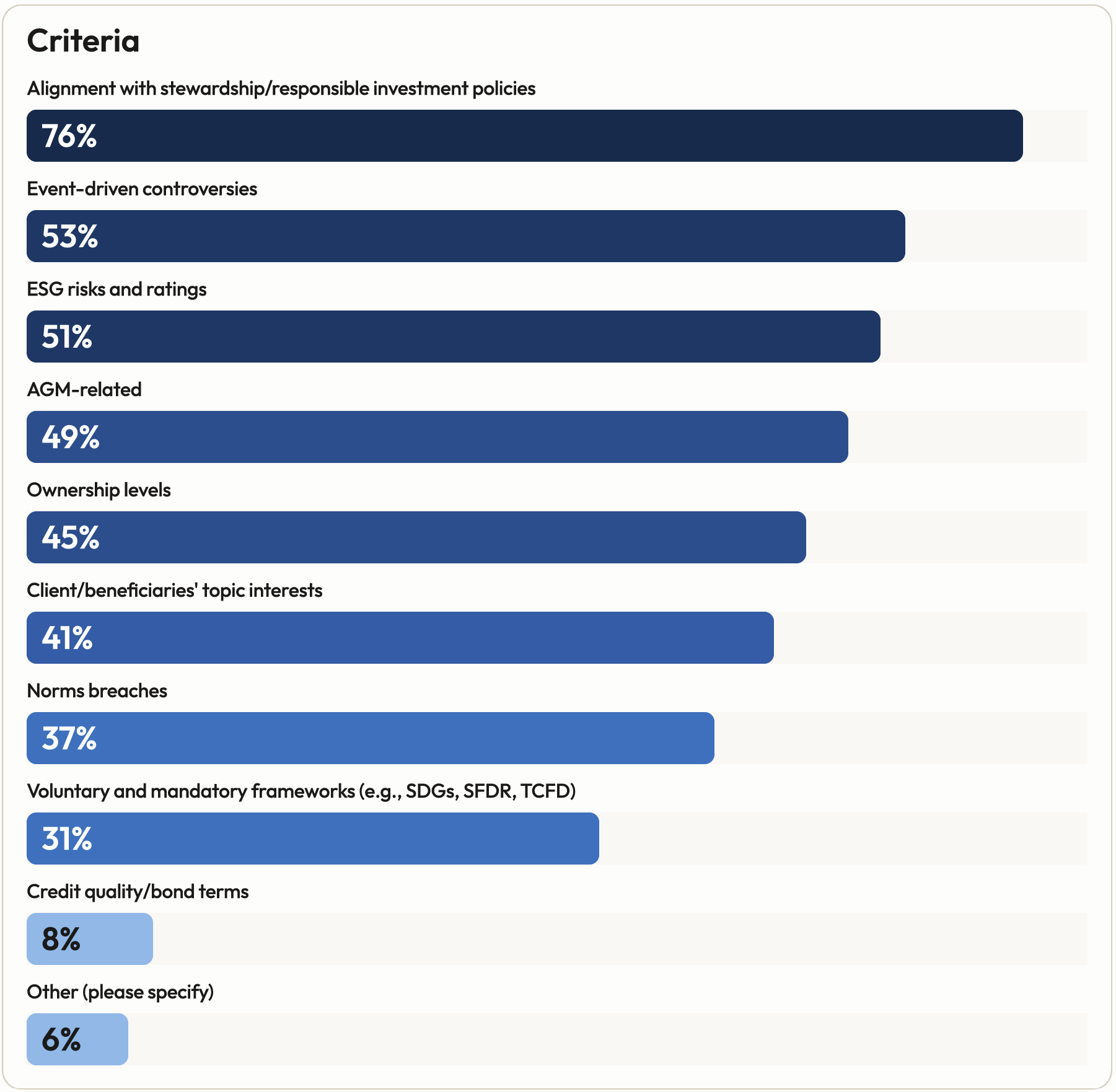
When asked about criteria used in engagement prioritization, all but one of the nine options provided were chosen by at least 30% of respondents, with “alignment with stewardship or responsible investment policies” the most common response (especially for asset owners who follow a single policy). The only outlier was “Credit quality/bond terms,” which was chosen by less than 10% of respondents (Figure 2).
This reflects how investors take a balanced approach to establishing priorities, while work is still needed on the fixed income side. Furthermore, under half of respondents consider ownership levels here, while larger investors (across the sub-segments of assets under management, stewardship or investment team sizes) are much more likely to do so, indicating the influence of organizational and analytical capacity in shaping stewardship strategy.
Figure 2. Summary of Respondent Criteria Used in Engagement Prioritization
Source: The 2026 Glass Lewis Stewardship Survey Report.
“Other” criteria listed by participants covered product requirements, exclusions and engagement mandates, materiality of the topics, and potential effort/success ratio.
Key Areas to Improve the Quality of Investment Stewardship
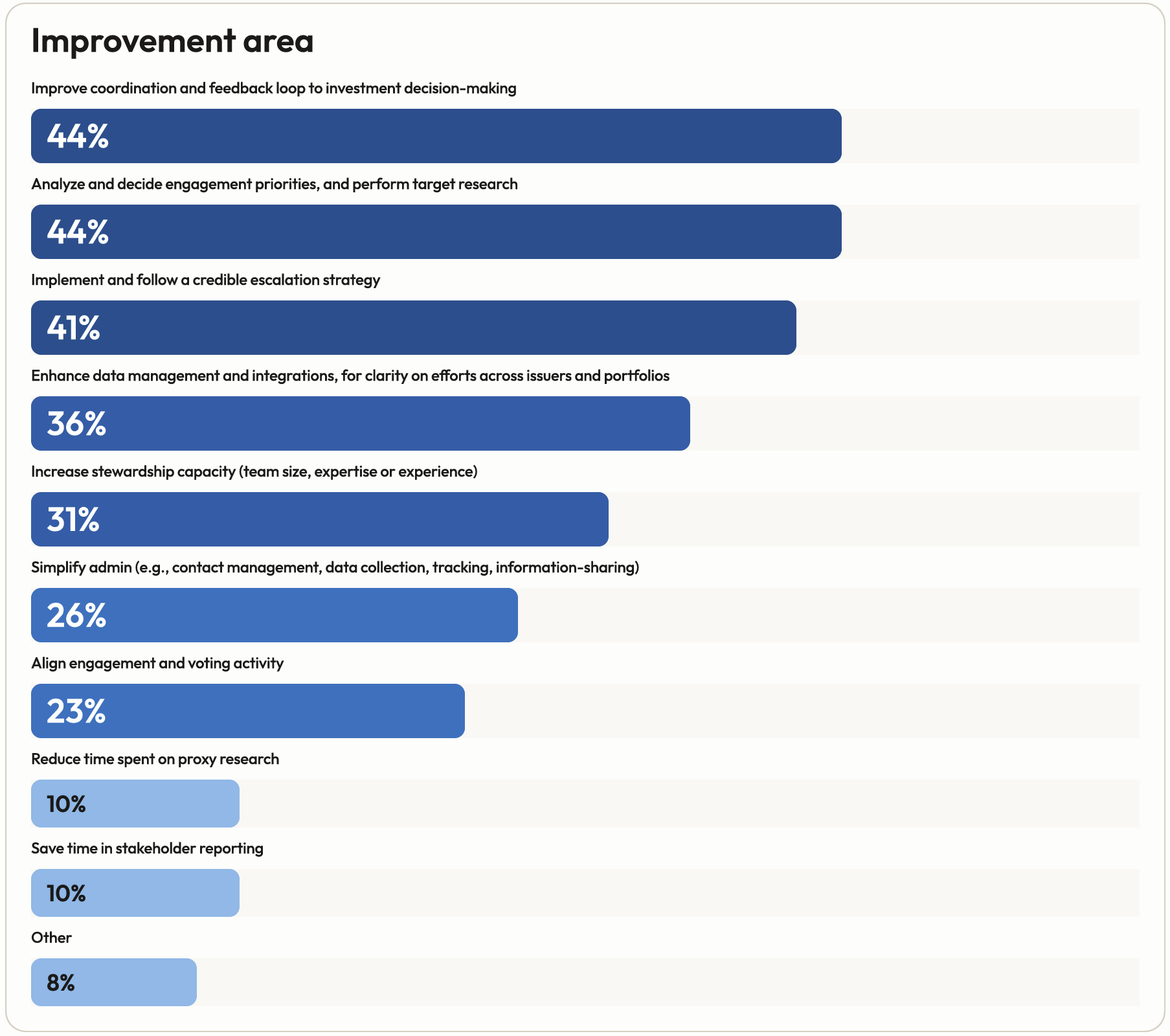
When asked to select the three key areas for improvement, the most frequently cited priorities focus on improving the feedback loop to investment decision-making, strengthening engagement prioritization and target research, and utilizing a credible escalation strategy (Figure 3).
Asset managers placed greater emphasis on tighter integration between stewardship insights and investment decisions, reflecting the importance of alignment across functions, while asset owners prioritized improving engagement prioritization and target research. Given how the latter was also ranked as the most time-consuming administrative task by the survey group, it could speak to a more complex situation for asset owners, many with both in-house and external asset management.
Figure 3. Summary of Respondent Areas for Improving Investment Stewardship
Source: The 2026 Glass Lewis Stewardship Survey Report.
Furthermore, one respondent reported a focus on improving outcomes reporting. This is central in evolving stewardship guidance such as the updated UK Stewardship Code,2 and closely linked to the area of data management and integrations, which 36% of respondents listed as a priority for improvement (Figure 3 above). It also aligns well with the importance of reporting as a use case for Glass Lewis’ Engagement Management Platform, where demonstrating undertaken efforts and progress over time is central to investors’ reporting strategies. Overall, the findings suggest that respondents view stewardship quality as closely linked to both analytical rigor and effective integration with investment processes.
For more insights on the current state of investment stewardship, download the 2026 Glass Lewis Stewardship Survey Report.
Notes and References
1 Glass Lewis. The 2026 Glass Lewis Stewardship Survey Report. 2026. https://grow.glasslewis.com/global-investment-stewardship-survey-insights-for-investors
2 Financial Reporting Council. UK Stewardship Code 2026. June 3, 2025. https://www.frc.org.uk/library/standards-codes-policy/stewardship/uk-stewardship-code/