Dispelling Uncertainty: A Structured Approach for Public Companies Managing Shareholder Vote Risk
Subscribe


Key Takeaways
- To be useful, forward-looking voting intelligence must connect projected support to specific shareholders’ voting history, published policies, and company-specific circumstances.
- Tailored scenario analysis can help teams assess potential concerns while proposals, disclosures and engagement plans are still taking shape.
- Board-ready reporting is strongest when the evidence, assumptions and level of confidence behind projected voting outcomes are transparent.
- Predictive insights are a complement to expert research, internal judgement, investor engagement and external advice.
- AI can accelerate the analysis of investor policies, voting history, and company disclosures, but voting projections are only dependable when grounded in a validated predictive methodology with explainable results.
In a previous article,1 I identified four key challenges that companies face in assessing shareholder voting risk: 1) looking beyond pass-or-fail outcomes, 2) managing compressed timelines, 3) prioritizing engagement, and 4) reporting to leadership. Addressing those challenges requires a structured approach that connects the array of investor signals already available to companies with the specific proposals and decisions companies are considering.
However, that structured approach also runs up against a fifth challenge. For corporate secretary, legal, investor relations, and compensation teams, assessing voting risk before a shareholder meeting relies on a combination of research, investor dialogue, company knowledge and external advice. Given the multiple teams and information streams involved, the organizational challenge is to synthesize insights early enough to inform decisions during key planning stages.
In this article, I examine how such an approach might also be structured to better support effective decision-making and drive stronger voting and engagement outcomes.
Connecting the Overall Voting Outlook to Specific Shareholders and Projected Support
Most companies have a strong sense of expected support before they face a vote. However, support projections are more useful when teams can see 1) which shareholders most impact the likely outcome, 2) where potential opposition is concentrated, and 3) how much a reversal in a particular shareholder’s voting decision could affect the outcome (Figure 1).
Figure 1. Example Analysis of Shareholder Vote Projections by Drivers, Opposition and Reversal

Source: Glass Lewis. Note: Illustrative example only. Shareholders and figures are hypothetical. Percentages are shown as a share of votes cast.
For IR teams planning outreach, this means connecting likely voting behavior with voting power and the concerns relevant to each investor. This can significantly inform engagement priorities, where, for example, a smaller shareholder whose published policy signals potential opposition may warrant more immediate attention than a larger holder expected to support the proposal.
Coverage also matters. Naturally, any estimate of future support among selected institutional shareholders should make clear how much of the company’s voting power the selected block represents. Assessing how much confidence to place in an overall outlook and where further information may be needed is essential for a company to be meaningfully prepared.
What Drives Votes: Making the Analysis as Useful as the Estimate
When an expected voting outcome is not aligned with management – whether in the context of a management proposal or shareholder proposal – understanding the factors driving the projection is essential to inform next steps.
A thorough analysis would connect expected votes to relevant investor voting policy provisions and voting history, company disclosures, and specific proposal terms. It is also critical to identify which policies indicate a prescriptive voting direction from those which leave substantial room for case-by-case judgment.
Historical votes provide additional valuable context, particularly where an investor has taken a consistent position. However, a truly forward-looking assessment needs to account for what distinguishes the current situation: whether that is the proposal itself, the investor’s policy, or other company circumstances.
Taken holistically, a careful analysis of drivers gives teams a basis for evaluating the projection, preparing questions, and deciding whether additional disclosure or engagement could be useful.
Testing Vote Scenarios to Inform Key Planning Discussions
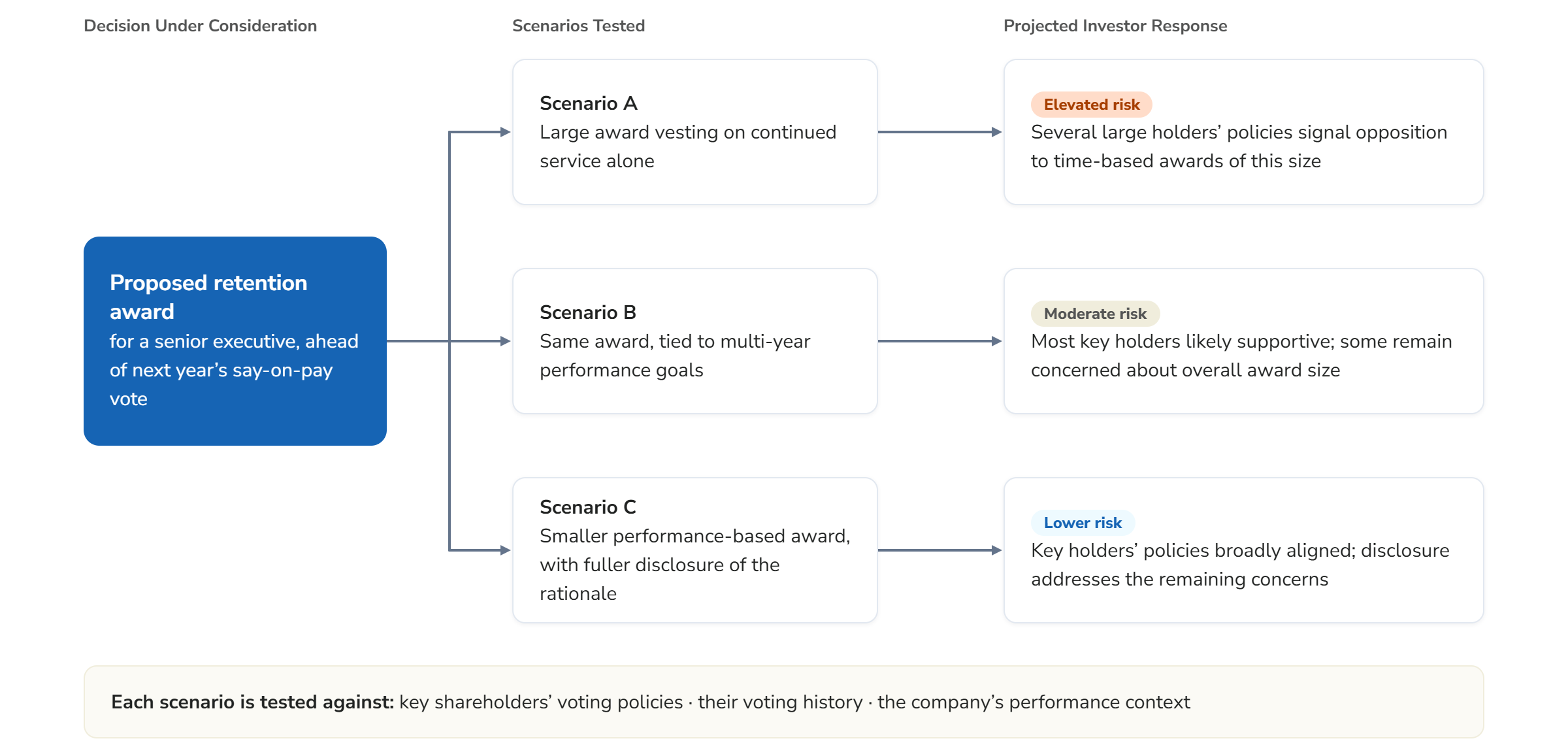
Many of the most important decisions that could affect voting outcomes are made well before a proposal reaches the proxy statement. For example, a compensation team considering a significant retention award may want to assess how different award structures could affect likely say-on-pay support. This requires more than a simple comparison with last year’s result, by digging deeply into how key shareholders’ policies may apply to newly proposed arrangements, as well as how the company’s performance context may affect perceived pay alignment (Figure 2).
Figure 2. Example Test Scenario for Executive Compensation Award
Source: Glass Lewis
External developments may also indicate a potential risk worth further investigation. For instance, a company that sees a shareholder-submitted proposal attract support at a peer competitor may want to assess its own exposure. A structured analysis of this exposure requires analysis of its shareholder base and relevant investor voting policies, as well as the company’s board policies and disclosures.
Proactively analyzing hypothetical future scenarios like these can help teams make informed decisions while their planning window remain open. The most valuable scenario analyses can clarify potential differences in investor response, and shed additional light on the governance, business, and compensation considerations that inform internal decisions.
Monitoring Ongoing Developments Year-Round
Investor policies, ownership, company disclosures and proposal draft language may all develop between an initial voting projection and the final vote, making timely insight into material changes that could affect voting outcomes critical.
This requires visibility into when an assessment was prepared, the information it reflects, and what has changed since each previous review. An updated support estimate is more useful when its explanation identifies the factors behind any movement.
This timely approach matters outside the immediate meeting window as well. During engagement planning, distinguishing a new policy concern from an established voting pattern or a company-specific development can help avoid redundant analysis and keep discussions grounded in relevant and current information.
Supporting Board and Executive Decision-Making Through Reporting
For corporate secretary and legal teams presenting voting projections to the board and executive management, the challenge is not simply communicating an expected level of support, but also a clear explanation of potential exposure, the investors most likely to affect the outcome, and the factors driving that assessment.
An effective internal report should connect expected support with potential concentrations of opposition, relevant investor policy concerns, and material changes since the previous assessment (Figure 3). It should also make clear where limitations in available information or investor coverage introduce uncertainty. This context helps leadership assess the significance of potential voting risk and consider where further action may be warranted.
Figure 3. Example Internal Report on Expected Vote Outcomes for Boards of Directors

Source: Glass Lewis. Note: Illustrative example only. Shareholders and figures are hypothetical. Percentages are shown as a share of votes cast.
Different internal stakeholders will naturally require different levels of detail. A compensation committee may wish to examine how specific elements of a proposed award could affect investor support, while the full board may require a broader overview of vulnerable agenda items and planned engagement. Ideally, the underlying analysis should provide a consistent foundation for discussions across the organization.
Complementing Established Expertise and Engagement
Developing a clearer understanding of expected voting behavior early can also allow for more proactive, strategic, and higher-value engagement with shareholders and external advisors.
For companies working with proxy solicitors, outside legal counsel or compensation consultants, a detailed internal assessment can support more focused discussions around which expected outcomes require further investigation, where interpretations of investor expectations may differ, and which concerns require additional consideration. For teams managing more of the process internally, the same analysis can help identify where external expertise may be most valuable.
As AI-enabled analysis becomes more widely available, it is important that the methodologies governing these outputs are informed by relevant domain expertise, supported by reliable source information, and subject to ongoing testing and validation.2 For voting projections to be useful and dependable, a solution must provide explainable results and confidence indicators with a sound methodological foundation as outlined above.
The value of any modeled voting outcomes is best realized when considered alongside expert research, direct investor engagement, external advice and the company's own understanding of its governance circumstances.
From More Information to More Useful Insight
Many companies recognize the importance of maintaining a broad view of voting risk throughout the governance calendar. Proposal planning, investor policy monitoring, peer analysis, shareholder engagement and internal reporting are closely related activities, despite responsibilities being spread across multiple teams.
A more structured, forward-looking approach can help companies maintain alignment across teams, assess likely shareholder behavior, and evaluate alternatives before key decisions are finalized. The true value of such an approach lies in translating these insights into more focused engagement, clearer board discussions and better-informed governance decisions throughout the year.
Notes and References
1 Riches, A. “Assessing Shareholder Vote Risks: An Overview of Four Key Challenges for Public Companies.” Glass Lewis. September 29, 2026. https://www.glasslewis.com/article/assessing-shareholder-vote-risks-an-overview-of-four-key-challenges-for-public-companies.
2 Gustitus, G. and Brutian, A. The Foundation Matters More Than the Model: Why Trusted Data and Human-Centric AI Will Define the Next Era of Investment Stewardship. Glass Lewis. June 10, 2026. https://www.glasslewis.com/ai/the-foundation-matters-more-than-the-model.