

Key Takeaways
- Cybersecurity oversight is now nearly universal at large cap companies. Defined board oversight of AI is emerging quickly, but still lags behind.
- Shareholder voting on board elections remained largely consistent in North America.
- While average opposition levels remained minimal among large European companies, instances of significant voting dissent on director elections more than doubled.
- Most large-cap European and UK companies met new rules on gender balance, however, executive diversity remains below board-wide levels across Europe.
- Board racial/ethnic diversity increased among North American and UK companies, but the trend of fewer U.S. companies providing aggregate or individual director reporting continued.
In the second instalment of our 2026 Proxy Season Global Trends, we provide a rundown of key takeaways relating to boards of directors from around the globe. Glass Lewis clients can access the full 2026 Proxy Season Global Briefing, which also covers shareholder rights and governance, executive pay, board composition and shareholder activism, via the content libraries on Viewpoint and Governance Hub.
Trends on AI and Cybersecurity Oversight
Cybersecurity oversight is now nearly universal at large cap companies. Defined board oversight of AI is emerging quickly, but still lags behind.
- In both the UK and Continental Europe, clear attribution of cybersecurity oversight has become standard practice , disclosed by over nine in ten large cap companies.
- Board oversight of AI is less established but is catching up quickly, present at around seven in ten large cap companies in Europe – a significant increase from the previous year.
- More than half of Continental European large caps have an AI policy in place, up from around one in five in 2025. Over four in ten UK companies have done the same.
- In the U.S., board oversight of cybersecurity issues is similarly well established among Russell 1000 companies with AGMs through June 2026, disclosed by nearly nine in ten and largely consistent with 2025.
- AI policies remain less prevalent but appear to be rising, with approximately 21% of Russell 1000 companies with AGMs through June 2026 having an AI policy in place, an increase from around 15% in 2025.
Trends on Shareholder Vote Results
Shareholder voting on board elections remained largely consistent in North America.
- In our overall U.S. coverage, 63 director nominees did not receive majority support (72 in 2025, 69 in 2024). Director elections in the Russell 3000 index also remained largely consistent with 28 directors who did not receive majority support in 2026 compared to 33 in 2025.
- Of these 63, only four have left their boards and 11 directors’ resignations have been rejected. The prevalence of plurality voting standards and resignation policies in the U.S. means that relatively few directors depart after failing to receive majority support.
- In Canada, only two director nominees failed to receive majority support, which is a significant decrease from previous years (10 in 2025, versus nine in 2024).
- While both directors submitted their resignations, only one director left their board; the other’s resignation was rejected.
While average voting opposition levels remained minimal among large European companies, instances of significant voting dissent on director elections more than doubled.
- Like in 2025, no uncontested director elections from large cap companies failed. However, approximately 5% of companies had director election proposals that received more than 20% opposition, up from ~2% in 2025. Belgium had the highest number of contentious director election proposals (17), followed by France and Germany, with 6 each.
Director opposition recorded a ten-year high in Australia.
- 26 board-endorsed directors at S&P/ASX300 companies received over 25% dissent in calendar year 2025 (2024: 17, 2023: 25), recording the highest figure in this decade. Dissent was driven by familiar issues: share performance, operational challenges, capital allocation and concerns over board composition.
- As in the past, there was a clear overlap between companies receiving remuneration strikes and those facing director dissent, with poor company performance often being the connecting factor.
Shareholder support in Japan averaged 96%, with dissent typically driven by governance concerns.
- Only 12 director nominees at Prime Market-listed companies received less than 60% shareholder support.
- Governance concerns — including insufficient capital efficiency, poor corporate performance, insufficient director independence and compliance and internal control issues — continued to drive shareholder opposition.
Trends on Gender Diversity
Most large-cap European and UK companies met new rules on gender balance.
- The EU Directive on Gender Balance on Corporate Boards requires large listed companies to have women hold at least 40% of non-executive director positions, or 33% of all director positions. Facing a June 30, 2026 deadline, 87% of European blue chip companies have board gender diversity at or above 40%.
- Transposition of the EU Directive into national law has been uneven across member states, and non-EU markets such as Switzerland fall outside of its scope.
- France has the highest regional average at nearly 47% gender diverse representation, with Italy, Iberia, and the Nordics close behind.
- The DACH and Benelux regions sit below average, at around 38% and 40%, respectively.
- In the UK, gender diverse directors held an average of 46% of board positions at FTSE 100 companies, above the FTSE Women Leaders Review’s target of 40%, which became effective at the end of 2025.
Executive diversity remains below board-wide levels across Europe.
- Gender diversity among executives remains markedly lower than at board level, with women holding approximately a third of executive roles, and variation remaining significant among European markets. At least one blue chip company has no gender diverse representation among executives in several markets, including Austria, Belgium, Germany, Denmark, Italy, the Netherlands, Sweden and the UK.
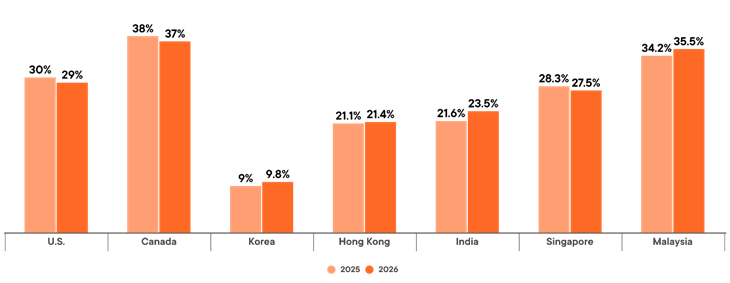
Figure 1. Comparison of Average Board Gender Diversity in Select Markets, 2025 vs. 2026
Source: Glass Lewis Research.
While increases to the proportion of women directors in Asia Pacific were generally modest, there has been a substantial reduction in the number of boards with no gender diversity.
- In Japan, the proportion of Prime Market-listed boards with no gender diverse directors fell to 2% from 2.8% in 2025, and 4.9% in 2024.
- Korea is on a similar trajectory, with the number of large company boards with no gender diversity falling from 5.6% in 2025 to 4.9% in 2026.
- The number of gender diverse directors in Korean board leadership positions, including committee chairs, board chairs, and CEOs, increased by 20% overall.
Trends on Ethnic Diversity
Board racial/ethnic diversity increased among North American and UK companies, but the trend of fewer U.S. companies providing aggregate or individual director reporting continued.1
- While U.S. board diversity reporting remains widespread, the proportion of Russell 1000 companies that disclosed the racial/ethnic diversity of directors on either the aggregate board or individual director level declined for the second consecutive year to 61%, from 70% in 2025, and 94.1% in 2024.
- Among companies that provided this disclosure, board racial/ethnic diversity levels remained roughly consistent for the S&P 500 (26.1% in 2026, 26.3% in 2025, and 25.3% in 2024) and Russell 1000 (25.1% in 2026, 24.8% in 2025, and 24% in 2024).
- In Canada, 85.7% of S&P/TSX 60 (86% in 2025) companies provided clear disclosure regarding board racial/ethnic diversity. Of these companies, average board racial/ethnic diversity was 16.9% (16.6% in 2025).
- Where ethnicities are disclosed in the UK FTSE 100 index, ethnic minority directors represent on average 18% of the board.
Notes and References
1 Because detailed board-level ethnic diversity reporting is not widespread in most markets, Glass Lewis only collects this data in the U.S., Canada, and the UK. For more information on board-level ethnic diversity, please refer to our special report, Glass Lewis. Ethnic Diversity in Corporate Governance – Global Overview. June 19, 2025. https://grow.glasslewis.com/ethnic-diversity-in-corporate-governance.