From Framework to Implementation: How to Operationalize the VOICE Method of Engagement
Subscribe

Key Takeaways
From engagement activity to evidence of influence, investor engagement is increasingly expected to demonstrate more than the volume of meetings held or letters sent. Asset owners need a clearer basis for assessing the quality and effectiveness of engagement across their managers, while investment managers need a credible and consistent way to show what their work has contributed to.
The French Sustainable Investment Forum (FIR) developed the VOICE method1 to help address this challenge. Drawing on a theory-of-change approach, it provides a common definition and analytical framework for distinguishing engagement activity from its effects, assessing the investor’s influence on a company, and reporting the evidence behind that assessment.
FIR encourages reporting aligned with VOICE for financial years beginning in 2027 and, where possible, for 2026. That creates a near-term implementation question for investors: whether today’s engagement records contain the structure and evidence needed for tomorrow’s disclosures.
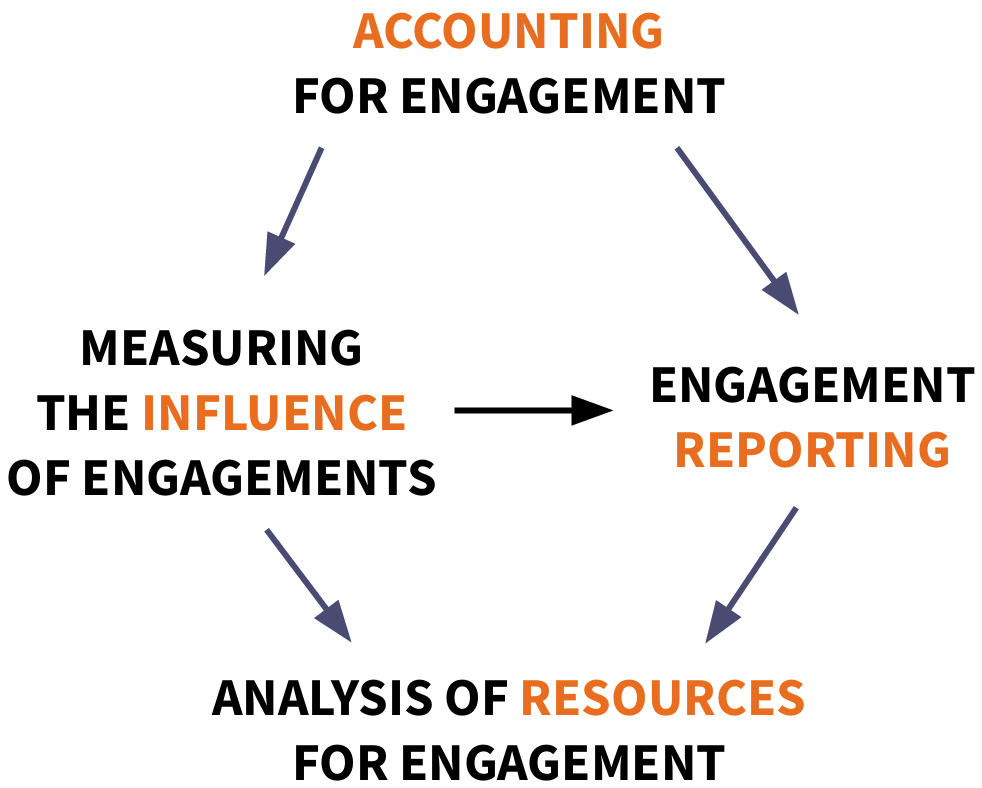
VOICE is designed for both asset owners and investment managers. Its toolkit covers four connected areas (Figure 1):
- Accounting for engagements consistently, including the underlying objectives and activities performed.
- Assessing influence at objective level using activities, outputs, outcomes and evidence.
- Reporting engagement activity and influence through a standardized set of categories.
- Assessing whether available resources (governance, people, technology, data) are adequate to support mandate expectations.
The methodology is not a claim that influence can be reduced to a fully objective score. FIR explicitly recognizes that judgment remains with the engager and that some subjectivity is unavoidable. The value of the framework lies in making that judgment more structured, transparent and evidence-based.
Figure 1. Visual Overview of VOICE Toolkit
Source: Forum pour l’Investissemant responsable.
Operationalizing VOICE Through a Central Stewardship System
A methodology becomes useful at scale only when it can be embedded in day-to-day stewardship processes. The Glass Lewis Engagement Management Platform (EMP) is designed to serve as a central operating system for stewardship – by bringing portfolios, holdings, entities, engagement initiatives, underlying objectives and milestones, activities, and voting information into one connected environment.
We reviewed the VOICE methodology against the EMP data model and underlying workflows. The tracking requirements it sets out can be supported today through a combination of templates, taxonomies and object relationships, capturing VOICE-specific information through configurable custom fields, with minimal custom development needed to further streamline the experience.
Alignment is not simply about adding a new reporting template at the end of the process. It requires a system that can preserve the underlying record of who engaged, why, against which objective, through which activities, what changed, and what evidence supports an assessment of influence.
A Connected Data Structure for Engagement Evidence
The EMP organizes stewardship information around connected record types:
- Entities and counterparties provide the company-level anchor, supported by one or more identifiers.
- Portfolios and holdings connect stewardship records to the relevant funds, mandates and periods of ownership.
- Engagement initiatives capture the overarching engagement, including its theme, rationale, owner, status and targeted companies.
- Objectives define the specific change sought from a company, while milestones and or custom fields provide verifiable steps or indicators of progress.
- Activities record the interactions and escalation actions undertaken, and can be linked directly to relevant objectives and milestones.
- Voting data can be linked to the same entity and engagement context, supporting a more integrated view of stewardship activity.
Unique record IDs connect these layers, allowing information to roll up from milestones and activities to objectives, engagements, companies, portfolios and mandates. This supports both case-level analysis and aggregated reporting without losing the underlying evidence trail.
The platform is also configurable. Administrators can create standard templates, controlled taxonomies and custom fields across these data groups in formats including text, dropdown, multi-select, date, number and checkbox fields. Field descriptions can be presented as tooltips, helping teams apply definitions consistently across users and reporting cycles.
Creating VOICE-Aligned Engagement Tracking
Engagements and Objectives
VOICE considers an engagement a substantiated request for change, formalized through one or more specific objectives, with an expectation of interactions with the company over time. The EMP can reflect this structure by recording the engagement rationale, ESG category and theme, start date, owner and engager role, then linking the engagement to one or more objectives.
At the objective level, teams can record the description, type, status, result and target date. Standardized objective libraries can promote consistency, while custom fields can accommodate VOICE categories such as transparency, operational or strategic objectives, company receptiveness and escalation actions.
Milestones, Outcomes and Verifiable Progress
VOICE expects objective achievement to be verifiable through factual quantitative or qualitative indicators. EMP milestones, custom fields and scales can be used to define and monitor evidence of progress, including capturing closing outcome(s), evidence link and influence.
This creates an important separation between activity and result: recording that a meeting took place is not the same as recording an output, an outcome, or evidence that the objective was achieved.
Activities and Escalation
The VOICE method recognizes activities including emails, virtual or in-person meetings, ongoing exchanges, formal letters, shareholder resolutions, interventions at general meetings and litigation. The EMP provides a standard activity library to capture these interactions, or custom activity types can be applied. Activities can be linked to objectives, and users can update the relevant objective or milestone from the activity record, preserving the connection between interaction and progress.
Escalation efforts can similarly be captured through an objective-level custom field with supporting narrative, and tagged on activity-level. Voting data imported to the platform can add further context where escalation includes voting against management or supporting a shareholder proposal.
Assessing Influence
VOICE defines five levels of influence, assessed when an objective is closed: no influence, not demonstrable, probable, very likely and recognized. The progression depends on evidence such as follow-up activity, an outcome aligned with the objective, converging evidence or feedback loops, and company acknowledgment.
The EMP can support this assessment by adding custom fields at objective level, to capture:
- Outputs described by the investor.
- Outputs or acknowledgment described by the company.
- Outcomes and evidence of company progress.
- The rationale and supporting evidence for the selected influence level.
- Links or attachments supporting private or public recognition.
This provides the record needed to apply VOICE consistently, but it does not automate the underlying judgment. Governance remains important, particularly for higher levels of influence, for which FIR identifies internal validation as good practice.
Table 1. VOICE Categories for Reporting
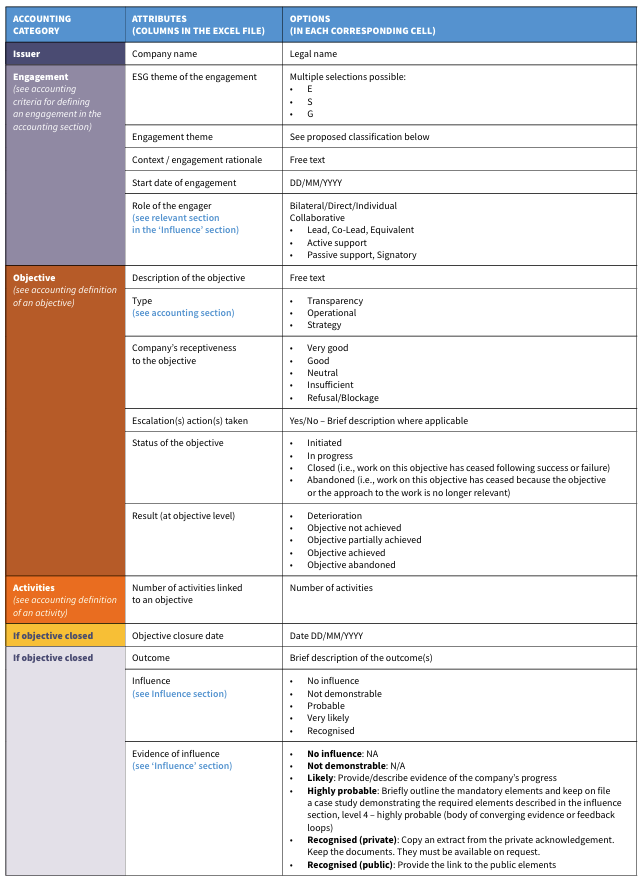
Source: Forum pour l’Investissemant responsable. Note: Click the image above for a downloadable spreadsheet showing how the VOICE categories align with the EMP.
From Consistent Tracking to Decision-Useful Reporting
Using the connected model outlined above, the EMP can support reporting aligned with the example in Appendix 42 at three levels:
- Aggregated reporting: portfolio- or mandate-level views of engagements, objectives, activities, results and influence classifications.
- Underlying data: structured exports of all the underlying data and evidence supporting reported totals and assessments.
- Case-specific reporting: Using either EMP PDF exports or underlying data to create detailed narratives of engagement rationale, objectives, undertaken efforts, progress, and next steps.
This structure helps reduce repeated manual reconciliation across client templates and reporting cycles. And using our Workspace Data Sharing capabilities, it is possible to share and consume stewardship data between connected workspaces, to improve transparency, operational efficiency, and reporting practices.
Technology is Part of Credible Engagement Resourcing
VOICE places technology within the wider set of resources required for effective engagement. It highlights the importance of adequate operational resources, including suitable software, dedicated budgets, specialist ESG data and high-quality external research. Appendix 6 asks explicitly whether an IT platform has been deployed to host, consolidate and disseminate engagement information.
Our inaugural Investment Stewardship Survey3 points to why this remains a practical challenge. Among respondents, cost considerations were the leading barrier to further stewardship technology adoption. As stewardship and investment teams grow, integration with existing systems becomes increasingly important.
Specialized technology can help institutions turn methodology into repeatable practice and increase coordination between stewardship and investment professionals, supporting collaboration around shared company and portfolio records.
This is also central to Glass Lewis’ integrated stewardship vision. By connecting engagement management with voting workflows in Viewpoint, and complementing those systems with expanding sustainability and climate research capabilities, we aim to give investors a more coherent foundation for research-informed engagement, voting and reporting – while preserving their agency over objectives, judgments and decisions.
Supporting the Market’s Move Toward Evidence-Based Engagement
The FIR VOICE method provides a valuable common language for moving from counts of engagement activity toward a clearer assessment of effectiveness and influence. Glass Lewis is committed to supporting that direction of travel. As part of the VOICE method working group, we are collaborating with industry participants to help operationalize the framework in practice.
If your organization is reviewing its engagement methodology, data model or readiness for VOICE-aligned reporting, we would welcome the opportunity to discuss your requirements and demonstrate how the EMP can support them.
Notes and References
1 Forum pour l’Investissem. The Voice Method: Measuring The effectiveness and Influence of Engagement. June 1, 2026. https://www.frenchsif.org/isr_esg/wp-content/uploads/FIR_Methode-Voice-GB_Interactif_08-06.pdf.
2 See p. 20 of #1 above.
3 Glass Lewis. The Glass Lewis Stewardship Survey Report. March 26, 2026. https://grow.glasslewis.com/global-investment-stewardship-survey-insights-for-investors.

.jpg)