Examining What Drove Significant Shareholder Opposition to S&P/ASX 300 Director Elections in Australia
Subscribe.png)


Key Takeaways
- In the 2025 AGM season, 26 votes with 25% or higher opposition against board-endorsed candidates were recorded across 19 S&P/ASX 300 companies.
- The degree of dissent was also up. Three board-endorsed nominees at James Hardie Industries plc received less than 50% shareholder support, and two directors at separate companies faced opposition exceeding 45%.
- While the relationship between returns and shareholder voting is not as strong for director elections as for remuneration proposals, directors at companies with relatively low shareholder returns were more likely to face high opposition.
- Drivers of shareholder opposition to director elections included remuneration issues, lagging share prices and value-destructive events, cross-board accountability, CEO succession, and outlier governance practices.
Australia’s most recent AGM season saw more director elections face higher levels of shareholder dissent than in prior years. Opposition was driven by issues across a range of areas, including executive remuneration,1 value-destructive events, 2 CEO succession issues,3 and outlier governance practices.4
Public company director elections represent one of the most direct and effective mechanisms for shareholders to ensure board accountability. Through the annual election process, investors can signal support for effective oversight or express concern where boards do not meet expectations.
This article, featuring excerpts from Glass Lewis’ 2025 Australia and New Zealand Proxy Season Review, provides data and analysis on director voting, along with discussion of the themes that drove shareholder opposition.
Director Opposition Levels
Australia’s 2025 proxy season saw a notable increase in shareholder opposition to director elections. During the year, 26 votes with 25% or higher opposition against board-endorsed candidates were recorded across 19 S&P/ASX 300 companies (Figure 1).5
Figure 1. S&P/ASX 300 Director Opposition Votes (25%+ Against)
.png)
Source: Glass Lewis Research. Data reflects the full calendar year.
The rise in the number of directors facing dissent was accompanied by an increase in the overall strength of opposing votes. Most notably, three board-endorsed nominees at James Hardie Industries plc received less than 50% shareholder support and were not elected to the board. In addition, two other directors at separate companies faced close votes, with opposition exceeding 45%. This represents a meaningful escalation from prior years, when directors were routinely elected and opposition levels rarely exceeded 40% (Figure 2).
Figure 2. Breakdown of S&P/ASX Director Opposition Levels

Source: Glass Lewis Research. Data reflects the full calendar year.
Shareholders continued to overwhelmingly reject externally nominated candidates who lacked board endorsement. The external nominee at BrainChip Holdings received the highest level of support among such candidates, at 18.0% of votes cast.
While the relationship between returns and shareholder voting is not as strong for director elections as for remuneration proposals, directors at companies with relatively low shareholder returns were more likely to face high opposition, as shown in Figure 3.
Figure 3. S&P/ASX 300 Companies with Director Opposition in 2025 vs. Total Shareholder Return Performance
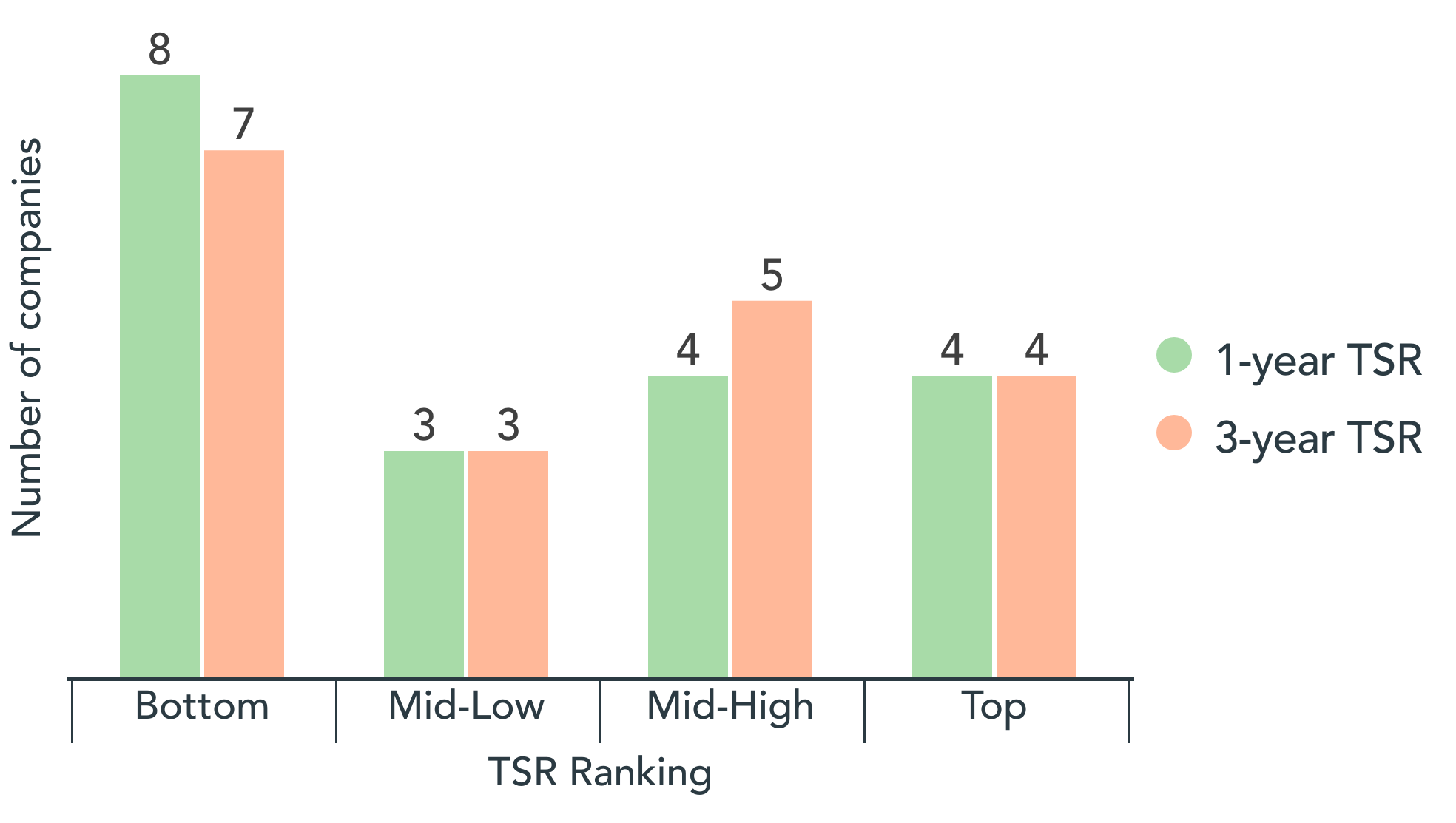
Source: Glass Lewis Research and Capital IQ. Note: TSR rankings measured against the S&P/ASX 300 peer group. Data reflects the full calendar year.
What Drove Shareholder Opposition?
Our commentary below focuses on director election proposals that attracted more than 25% dissenting votes, indicating material shareholder disagreement. The 25% threshold mirrors the benchmark applied to remuneration strikes. The aim is to highlight the likely factors contributing to shareholder dissent; however, no shareholder polling has been conducted to determine voting motivations. Accordingly, the discussion is limited to an assessment of potential issues based on publicly available information.
The following themes emerged as primary drivers of director opposition votes in 2025, with vote outcomes captured in Table 1.
Table 1. Summary of Notable Director Election Proposals With More Than 25% Dissent

Source: Glass Lewis Research
Remuneration Issues
There continues to be a clear connection between remuneration strikes and votes against directors. Nine of the 19 companies that recorded opposition to director elections also experienced remuneration strikes. Shareholders increasingly escalated concerns by voting against remuneration committee chairs. Where those chairs were not standing for election, opposition was often directed at other remuneration committee members or the board chair. A dominant theme was shareholder fatigue with boards that repeatedly failed to respond meaningfully to remuneration feedback.
Notable Vote Example: Dicker Data
Shareholder opposition was likely linked to Leanne Ralph’s role as chair of the remuneration committee and the board's response to ongoing shareholder concerns, culminating in a fifth consecutive remuneration strike. Despite the continued opposition, executive pay remains largely underpinned by uncapped profit-share cash bonuses – a structure that some shareholders deem excessive, with three executive directors entitled to receive 8% of company profits.
Lagging Share Prices and Value-Destructive Events
Often closely linked to remuneration dissatisfaction, weak share price performance remained a major driver of director opposition. The strongest votes against directors clustered around boards perceived to have failed to take accountability following significant shareholder value destruction.
Notable Vote Example: James Hardie Industries (JHX)
JHX faced a highly scrutinized AGM following its controversial acquisition of AZEK Company Inc, which triggered a material share price decline and significant investor backlash. Shareholder approval for the US$8.75 billion transaction was not required, and the ASX granted a waiver from Listing Rule requirements to allow the share issuance used to fund the acquisition to proceed without a shareholder vote.
Many JHX shareholders, or former shareholders who exited following these events, publicly expressed frustration with management and the board. This discontent was compounded by what was widely perceived as very limited contrition or accountability from the board in response to the backlash.
The loss of shareholder trust culminated in the removal of three directors, including board chair Anne Lloyd. Two of the three newly appointed AZEK-affiliated directors also attracted significant shareholder opposition due to having previously served overlapping executive tenures at The Valspar Corporation with JHX CEO Aaron Erter, raising concerns about their capacity for independent oversight of the CEO. The remaining AZEK-affiliated director, former AZEK CEO Jesse Singh, was free from similar affiliations to the JHX CEO and received strong shareholder support for his election.
Cross-Board Accountability
Four opposition votes were linked to directors’ roles on other boards. This reinforces that investors often assess directors holistically, rather than in isolation based on performance at a single company.
Notable Vote Examples: Westpac Banking, Mirvac, and QBE Insurance
The opposition to Peter Nash at Westpac and Mirvac, and to Yasmin Allen at QBE, likely reflected shareholders’ assessment of their performance on the board of ASX Limited, as well as on its audit and risk committee, where Nash served as chair and Allen as a member. Recent developments at ASX point to shareholders’ concerns about a failure to manage operational risks effectively, with issues extending back several years. They may have viewed insufficient oversight and response as ultimately allowing these risks to crystalize in a major operational incident and a corresponding loss of shareholder value.
CEO Succession
Two votes followed abrupt CEO departures that highlighted weaknesses in governance processes.
Notable Vote Example: Deep Yellow
Deep Yellow experienced material shareholder backlash in late 2025 following the abrupt and poorly communicated departure of long-serving MD/CEO John Borshoff. Given Mr. Borshoff’s status as a founder and his role in growing the company, the lack of transparency seemed to have unsettled investors.
This discontent spilled into the November 2025 AGM. A resolution to re-appoint Greg Meyerowitz, the non-executive chair of the audit committee, passed only narrowly, while another director up for re-election, Victoria Jackson, recorded 22% opposition. The remuneration report also attracted 22% opposition, falling short of a strike but signaling elevated protest voting across multiple resolutions. Shareholders also overwhelmingly rejected the equity grant to the former MD/CEO, with 85% of votes cast against the proposal, after the board elected to retain it on the ballot following his resignation.
Governance Practices
Perceived overcommitment and concerns around director independence also featured at a small number of AGMs.
Notable Vote Example: Harvey Norman Holdings
The company’s board, led and largely controlled by co-founder and executive chair Gerry Harvey, is characterized by very limited representation of demonstrably independent directors. Instead, it includes four executive directors and seven directors with tenures exceeding 18 years. This structure may represent a governance red flag for many investors, who appear to question the board’s ability to provide effective oversight of the founder and have concerns about the absence of any clear plan for board renewal or succession. Kenneth Gunderson-Briggs, while classified as independent by the company, has served on the board for more than 22 years and chairs its key committees.
Notes and References
1 Peach, Joshua. “The great tech revolt and 4 other surprising stats from AGM season.” Australian Financial Review. December 7, 2025. Accessed February 13, 2026. https://www.afr.com/markets/equity-markets/the-great-tech-revolt-and-4-other-surprising-stats-from-agm-season-20251127-p5nizg
2 Murdoch, Scott. “James Hardie faces board upheaval as investors react to $8.8-billion US takeover.” Reuters. October 30, 2025. Accessed February 13, 2026. https://www.reuters.com/sustainability/boards-policy-regulation/james-hardie-proxy-shareholders-reject-chair-anne-lloyds-director-election-2025-10-29/
3 Wembridge, Mark. “Deep Yellow names new chief executive after investor backlash.” Australian Financial Review. December 2, 2025. Accessed February 13, 2026. https://www.afr.com/companies/mining/deep-yellow-names-new-chief-executive-after-investor-backlash-20251202-p5nk2m
4 Molnar, Nick. “A Glancing Blow to Peter Nash.” Rampart. December 10, 2025. Accessed February 13, 2026.https://www.rampart.news/a-glancing-blow-to-peter-nash/
5 Glass Lewis. 2025 Australia and New Zealand Proxy Season Review.