





Key Takeaways
This guide explores how Glass Lewis’ Climate Intelligence can support investment research by helping investors identify whether climate transition exposure represents a financial risk, or opportunity, for investee companies. The assessment focuses on the evidence behind company strategies and execution, and considers how those findings may inform financial assumptions. Using company examples, it illustrates how climate transition-related developments can connect to areas such as costs, revenue expectations and long-term asset values across the investment research process.
How the Climate Transition Can Affect Investment Assumptions
An investor deciding whether the market is pricing a company correctly typically aims to forecast things such as production costs, customer demand and how long assets will keep earning money.
The transition to a lower-carbon economy can change each of these assumptions: carbon regulation can raise production costs; shifting customer demand can shrink one product line and grow another; assets built for a higher-carbon economy may stop earning money before the end of life assumed in the accounts. These changes, in turn, can affect the forecasting models that investors use.
Glass Lewis’ climate transition research gives analysts insight into those developments. It adds three considerations to the research process:
- Climate transition exposure: Climate Intelligence identifies the business activities through which the transition could affect a company's costs, revenue or asset values, including exposures that industry classifications or emissions data can miss.
- Management response tested against evidence: The model takes an evidence-based approach to assessing management’s transition strategy and execution. A stated target carries less weight than committed capital, and committed capital carries less weight than a capital project that is already built and operating.
- Relative performance in a climate transition economy: It highlights companies and peers the climate transition may favor or hurt more than baseline assumptions reflect, and explains what drives the difference.
The outputs are different from typical climate ratings. They provide insights that can inform, or challenge, the assumptions already in an analyst's valuation.
From Exposure to Financial Adjustment: Three Companies
Whatever valuation method is used, the impact of the climate transition tends to be considered in the same three places: the cost of producing goods, the revenue a company can expect, and the value of its long-lived assets. How these factors are weighted varies by company, even within the same industry, due to the specific activities that drive each company's costs, demand or use of assets.
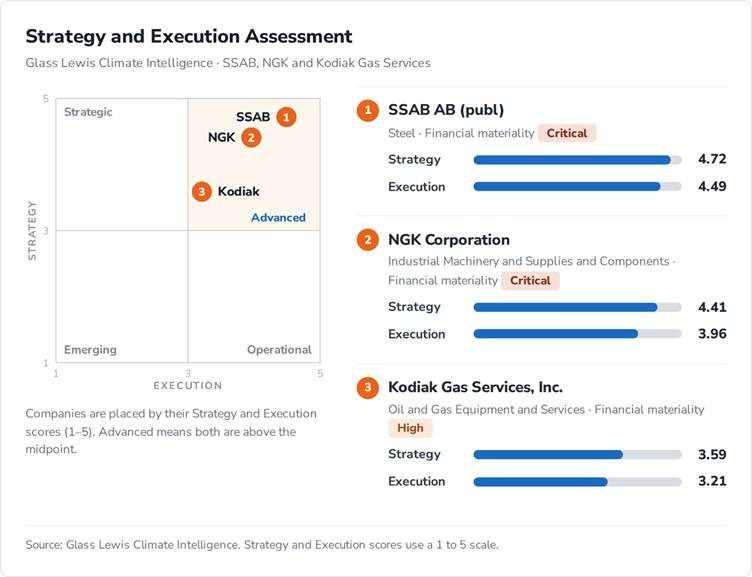
Figure 1 below illustrates the broad lens through which Climate Intelligence assesses companies’ financial exposure to the transition: their strategy, and how it is being executed. All three companies are rated Advanced by Climate Intelligence, but their scores differ widely. SSAB scores highest on both strategy and execution, while Kodiak sits closest to the midpoint. For all three, execution trails strategy.
Figure 1. Comparative Strategy and Execution Assessment: SSAB, NGK and Kodiak
Source: Glass Lewis Climate Intelligence.1
The three examples below show what Climate Intelligence adds to a standard research process. Each company illustrates one of the typical ways that climate transition impact is considered in financial valuations: lower future costs at SSAB, new revenue expectations at NGK and the long-term value of assets at Kodiak Gas Services.
Determining the Future Costs for a Steelmaker: SSAB
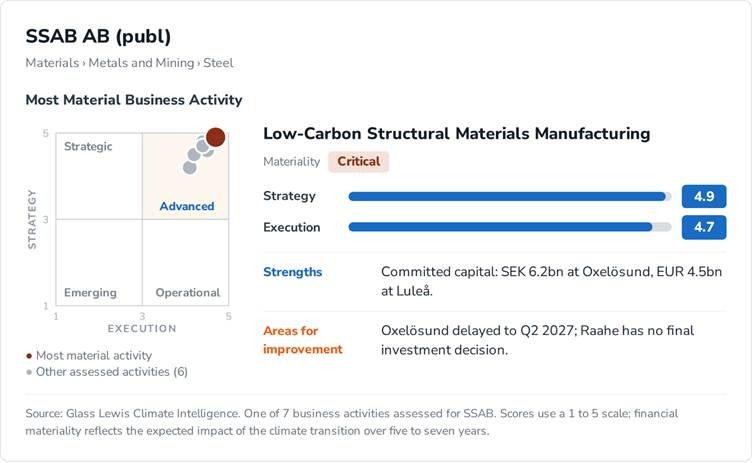
Figure 2. Climate Intelligence Analysis: Most Material Business Activity for SSAB
Source: Glass Lewis Climate Intelligence.
Exposure to the Climate Transition
SSAB, the Nordic steelmaker, is replacing the blast furnaces at its sites in Sweden and Finland with electric arc furnaces. The replacement should reduce coal consumption, emissions and the need to buy carbon allowances. That matters financially because conventional steel production carries a direct cost under the EU emissions trading system: SSAB paid SEK 724 million (US$72.5 million)2 net for allowances in 2025. That cost is expected to rise as free allowances are phased out from 2026.
The forecasting question is: how much will SSAB’s carbon costs rise if it continues producing steel through conventional blast furnaces, and how much of that cost could disappear if the company successfully changes its production system?
Addressing Exposure Through Strategy and Execution
SSAB has moved beyond target setting and has committed capital to changing how it makes steel. Oxelösund is the first site to convert. SSAB has committed SEK 6.2 billion (US$618.7 million) to the furnace and raw material handling, plus about SEK 2 billion (US$199.7 million) for the power connection. Start-up for the site is now targeted for Q2 2027 after a permitting delay.3 The larger project is a EUR 4.5 billion (US$5.2 billion) mini-mill at the Luleå site, scheduled to start production in late 2029. A third conversion at Raahe is planned for after 2030, but has not yet received a final investment decision. Oxelösund and Luleå can therefore support assumptions about future production. At this time, Raahe cannot.
Evidence-Based Financial Adjustment
The evidence supports a positive adjustment to SSAB’s future cost assumptions, although the timing remains uncertain. SSAB expects its new production system to reduce production cost per tonne by about 15% and roughly halve fixed costs. It also expects Luleå alone to improve annual earnings by more than SEK 5 billion (US$499.1 million), while avoiding maintenance spending that would otherwise have been needed to keep the old furnaces running. The key questions for an analyst are: when does the new capacity become operational? And how much of the expected cost reduction is credible enough to enter the forecast? The delay at Oxelösund shows why savings should not be assumed to arrive exactly when management first planned, and any savings tied to Raahe should be treated with more caution until it is approved.
Evaluating the Revenue Forecast of a Ceramics Manufacturer: NGK
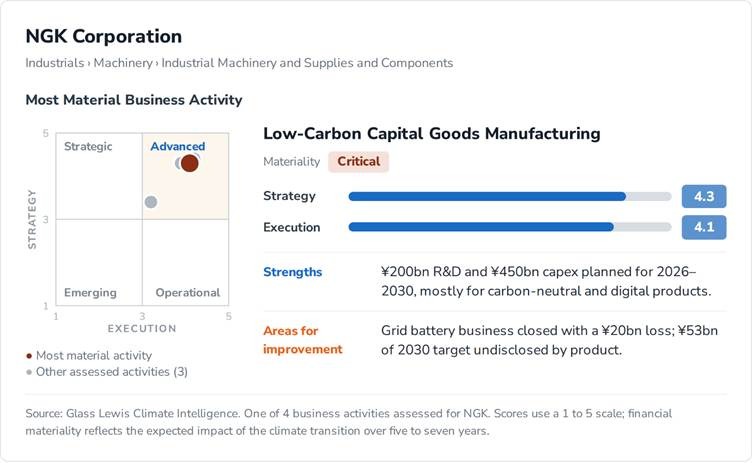
Figure 3. Climate Intelligence Analysis: Most Material Business Activity for NGK
Source: Glass Lewis Climate Intelligence.
Exposure to the Climate Transition
NGK is a Japanese ceramics manufacturer whose current business remains heavily exposed to combustion engines. At the same time, the company is investing in products intended to benefit from decarbonization and digitalization. NGK wants carbon-neutral and digital products to account for 50% of sales by 2030, compared with 30% in 2021 and about 35% today. Its exposure therefore runs in both directions. Over time, vehicle electrification threatens part of its existing combustion-engine business. But the climate transition also creates potential demand for new products.
Addressing Exposure Through Strategy and Execution
NGK is putting substantial capital behind its growth strategy. Between 2026 and 2030, it plans ¥200 billion (US$1.26 billion) of research spending and ¥450 billion (US$2.85 billion) of capital investment, with most research spending and more than half of capital investment supporting carbon-neutral and digital products.4 The company is targeting ¥100 billion (US$632.2 million) of new-business sales by 2030.
Execution has been less convincing. In October 2025, NGK closed its sodium-sulfur grid battery business, recorded a ¥20 billion (US$126.5 million) loss. Its president also acknowledged in the NGK Report 2026 that the NV1000 new-business effort had not yet produced sufficient results. Combustion-engine substrates and sensors still accounted for about 55% of sales in the year to March 2026. NGK expects those sales to rise again next year as electric-vehicle adoption develops more slowly than previously expected.
Evidence-Based Financial Adjustment
The evidence does not yet support a positive adjustment to NGK’s revenue forecast. Its ¥100 billion (US$632.2 million) 2030 new-business target is significant and includes ¥33 billion (US$209 million) from batteries and ¥14 billion (US$88.7 million) from carbon capture, with the remaining ¥53 billion (US$335.8 million) undisclosed by product. However, the closure of the grid battery business and limited progress elsewhere present reasons for caution on timing and probability for meeting its forecast. Meanwhile, slower electric-vehicle adoption may extend demand for existing combustion-engine products. That partly offsets the slower development of new businesses in the near term.
Assessing Downside Asset Value Risk of a Natural Gas Service: Kodiak Gas Services
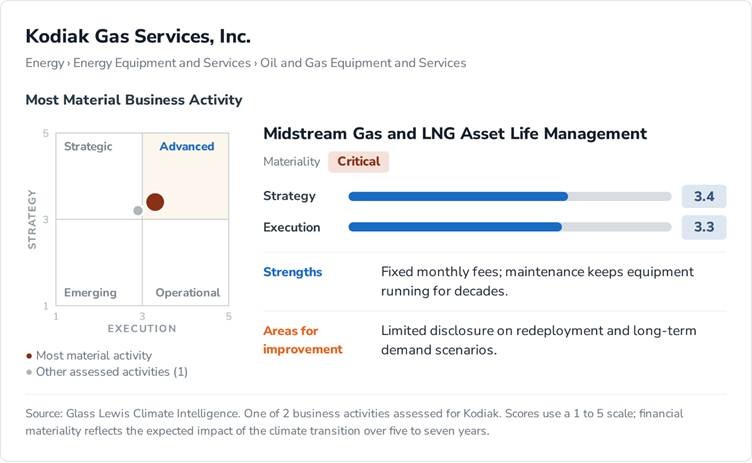
Figure 4. Climate Intelligence Analysis: Most Material Business Activity for Kodiak Gas Services
Source: Glass Lewis Climate Intelligence.
Exposure to the Climate Transition
Kodiak Gas Services rents compressors to the U.S. natural gas industry. Its machines are used to move gas through gathering systems and pipelines. Standard industry classifications put it in energy equipment and services rather than gas infrastructure, so a screen for pipeline exposure might miss it. Its near-term revenue is relatively predictable because customers generally pay fixed monthly fees. The longer-term question is different: how long will the equipment continue to find customers and earn money? A depreciation schedule of 20 or 25 years is only reasonable if the asset can keep earning for that long. If demand fades earlier, its economic value may be lower than the balance sheet suggests.
Addressing Exposure Through Strategy and Execution
Kodiak’s maintenance programs can keep compression equipment operating for decades, while its accounting lives range from 4 to 25 years. Customer contracts generally last only 1 to 7 years, and about 9% of the equipment it rents out, measured by capacity, was operating under month-to-month contracts at the end of 2025. Short contracts do not necessarily mean the assets are overvalued, because compressors can be redeployed to new customers. But redeployment is a key assumption, and Kodiak provides limited information to test it. The company warns that lower gas demand linked to climate change and potential asset impairments could hurt the business, but does not show how its fleet would perform under different long-term demand scenarios.
Evidence-Based Financial Adjustment
The evidence points to downside risk in Kodiak’s long-term asset assumptions, rather than a demonstrated impairment today. If Kodiak can continue redeploying compressors, their long useful lives may be reasonable. But if gas demand weakens and equipment becomes harder to place, some assets could earn money for less time than assumed and be worth less than their balance-sheet value. Kodiak recorded only $6.3 million of impairment on long-lived assets in 2025, so the accounts do not currently indicate a major problem. However, limited disclosure means analysts should remain cautious and monitor utilization, contract renewals and evidence that equipment can be redeployed.
What Climate Intelligence Adds
The three company examples show what Climate Intelligence adds to a standard research process, adding insights in three ways:
Surface exposures that are easy to miss: A ceramics manufacturer is not an obvious candidate for significant climate exposure, but NGK has both opportunities and risk. Most of its sales still come from combustion-engine products that vehicle electrification threatens, while its growth plans depend on products the transition could favor.
Weigh management's response by the evidence behind it: At SSAB, committed projects under construction support lower future costs. At NGK, large investment plans have not yet produced enough evidence to put its new-revenue target into the forecast.
Show who is better or worse placed, and why: SSAB may be better placed than baseline assumptions reflect, because committed investment should lower its future costs. Kodiak may be worse placed, because its assets depend on gas demand lasting as long as their assumed lives. The signs to watch are project start-up dates at SSAB, new-business sales at NGK, and fleet utilization and contract renewals at Kodiak.
Using this framework, climate transition factors enter a valuation the way any other evidence should: through reasoned assumptions and only to the extent that the evidence supports it.
Where It Fits in the Investment Process
Investment teams can use the research at multiple stages of the investment process:
- Investment screening: The materiality rating can help investors prioritize where deeper research may be most valuable. Across a broad universe, differentiating between Critical, High, Moderate and Low materiality can provide an additional lens for allocating research time and focusing attention on the exposures most likely to matter financially.
- Valuation model: Business Activity-level insights can help investors examine which transition-related assumptions may warrant consideration in forecasts and valuations. The underlying evidence can provide context on where management plans are supported by demonstrated progress, where uncertainty remains, and which financial variables could merit further analysis.
- Engagement and stewardship: The research can help surface areas for further discussion with management. Areas for improvement, or differences between strategy and execution, for example, can point investors toward more specific questions about implementation, capital allocation, or other evidence needed to assess whether stated plans are translating into results.
- Monitoring and review: Company-specific evidence, peer insights and monitorable developments can provide reference points for revisiting an investment thesis over time. Investors may choose to track certain signals across holdings to assess when further analysis is warranted and whether model assumptions continue to hold or not.
Across the investment process, Climate Intelligence can therefore provide an additional evidence layer for investors considering financially material transition factors. Rather than prescribing how those insights should be incorporated, the research is designed to help investors identify relevant exposures, assess the evidence behind company responses, and connect those findings to the financial questions that matter to their own investment process.
Climate Intelligence is now part of a broader suite of climate solutions across Glass Lewis and Clarity AI, bringing together complementary capabilities across carbon footprinting, climate transition and physical risks, scenario analysis and reporting tools to support investors across different stages of the investment and stewardship process.
Notes and References
1 Company figures are drawn from Glass Lewis Climate Intelligence assessments and traced to the public documents below. For informational purposes only; not investment advice. Figures reflect the cited sources as of their publication dates and should be verified before use.
SSAB, year ended 31 December 2025. Annual Report 2025, published 17 March 2026; Q4 and full-year 2025 report, 28 January 2026; Q1 and Q2 2026 reports; Capital Markets Day presentation, 4 November 2025, which is the source for the cost and capital expenditure figures; Oxelösund investment release, 2 June 2023; Luleå mini-mill release, 2 April 2024; Science Based Targets initiative approval release, 18 June 2024; commissioning delay release, 11 May 2026.
NGK, year ended 31 March 2026. NGK Report 2026, published August 2026; Long-term Management Plan 2026 to 2035, 28 May 2026; financial results presentation for the year ended 31 March 2026, published 30 April 2026; NGK Report 2025. Note that NGK labels the year ended 31 March 2026 as FY2025, and that the company was renamed from NGK Insulators to NGK Corporation on 1 April 2026.
Kodiak Gas Services, year ended 31 December 2025. Form 10-K filed 26 February 2026, including Item 1, Item 1A and Notes 2, 6 and 10; Q4 and full-year 2025 earnings release, 25 February 2026; Form 10-Q for the quarter ended 30 June 2026, filed 7 August 2026; 2023 climate-related financial disclosures report.
2 All currency conversions applicable at the time of publication.
3 Commissioning of the Oxelösund electric arc furnace was delayed in May 2026 by an appeal against the grid connection permit. SSAB said it expected no material effect on 2026 earnings or cash flow. SSAB news release, 11 May 2026, and Q2 2026 report.
4 These figures come from the Long-term Management Plan 2026 to 2035, published 28 May 2026, which replaces an earlier plan to spend ¥300 billion on research across 2021 to 2030. Actual research spending over 2021 to 2025 was ¥142.7 billion.